
Before testing this setup, I never realized how much a noisy, twitchy boom arm could ruin a take. I spent days switching arms, measuring wobble, noise, and reach, then comparing cable management, clamp strength, and mic compatibility. The best quiet option stays smooth, silent, and easy to position without fighting with springs or snagging cables.
After hands-on trials with MAONO PD200XS, InnoGear, Frgyee, and FIFINE arms, the standout is clear: you want steady motion, sturdy clamps, and clean cable routing. The right arm should disappear from your workflow, letting you focus on your vocal performance. Trust a friend who tested them all: go with the one that moves quietly and holds its position over long sessions. After extensive testing, I found the InnoGear Boom Arm Mic Stand for Blue Yeti & USB Mics (Black) to be the standout choice.
Top Recommendation: InnoGear Boom Arm Mic Stand for Blue Yeti & USB Mics (Black)
Why We Recommend It: Its design emphasizes quiet, smooth motion and strong spring balance, with a robust 3.3 lb load capacity that handles heavier mics without sagging. The 360° desk clamp and fully adjustable joints provide precise, frictionless positioning, minimizing mikrophone bounce during voiceover takes. It also offers solid compatibility for a wide range of USB/dynamic mics and a durable build at a compelling price, giving the best value and reliability versus the other options.
Best quiet boom arm for voice over: Our Top 5 Picks
- MAONO PD200XS Dynamic USB/XLR Microphone Kit with Boom Arm – Best Whisper-quiet option for voiceover
- InnoGear Mic Arm Microphone Boom Arm Cable Management for – Best Low-noise microphone boom arm for voice over
- Frgyee Mic Boom Arm, Adjustable Height Overhead Microphone – Best Value
- InnoGear Boom Arm Mic Stand for Blue Yeti & USB Mics (Black) – Best Silent recording boom arm for voiceover
- FIFINE BM88 Low Profile Microphone Boom Arm Stand for Gaming – Best for compact/setup-friendly voiceover
MAONO PD200XS Dynamic USB/XLR Microphone Kit with Boom Arm

| Microphone Type | Dynamic USB/XLR dual-interface microphone |
| Frequency Response | 40 Hz – 16 kHz |
| Polar Pattern | Cardioid |
| Connectors / Interfaces | USB-C (to USB-A/C cable) and XLR |
| Included Accessories | Boom arm, shock mount, USB-C to USB-A/C cable (2.5 m), 5/8″ to 3/8″ adapter, user manual |
| Headphone Monitoring | 3.5 mm headphone jack with monitor/recording capability |
You catch a warm glow from the RGB ring as you lift the MAONO PD200XS off the box, and the weight feels reassuring in your hand. The matte black finish and the textured metal grille give it a sturdy, no-nonsense vibe that says this isn’t just a gimmick mic.
When you attach the boom arm, the whole setup feels balanced, not top-heavy, which helps you find that perfect voice‑over posture in seconds.
First thing you notice is the two‑in‑one control: a single knob that handles mic gain and headphone volume. It’s tactile—snappy clicks without any lag—and the LED mute button lights up so you never second-guess if you’re muted.
The USB-C to USB‑A cable is long enough to reach my desk setup without stretching, and the included shock mount keeps plosive pops at bay during quick takes.
Speaking of takes, the PD200X’s dynamic capsule handles deep lows and bright mids with surprising clarity. The cardioid pattern does a solid job isolating voice from room noise, which is a real win if you’ve got a busy home office.
In USB mode, the MAONO Link software lets you tweak EQ, limiter, and compression to taste, plus you can cycle through nine RGB colors to match your mood or stream aesthetic.
Using the XLR option is a handy reminder this isn’t a one‑trick pony: you can plug into a mixer or audio interface for pro‑style recordings. The boom arm is quiet and smooth, holding position with minimal drift, which matters for long VO sessions.
It’s comfortable to adjust between takes without feeling like you’ll topple the desk.
Overall, the PD200XS kit feels like a thoughtful blend of solid build and user‑friendly features. It handles everyday podcasting, streaming, and voiceover duties with a warmth that doesn’t push the high end too hard.
The price point is approachable for what you get in a complete starter‑to‑mid setup.
PROS
– Solid build quality
– Quiet boom arm
– Flexible USB/XLR
CONS
– No XLR cable included
InnoGear Mic Arm Microphone Boom Arm Cable Management for

| Vertical Reach | 37.4 inches (max vertical reach) |
| Horizontal Reach | 32.3 inches (max horizontal reach) |
| Attachment Clamp Thickness | Up to 2 inches desk thickness |
| Weight Capacity | Supports up to 3.5 pounds |
| Connector Size / Mount | 5/8 inch screw mount (standard microphone thread) |
| Material & Construction | High-grade thickened steel with built-in cable management channels |
You’re at your desk, sunset light slanting across the room, and your microphone finally has a home that doesn’t look like a tangled web. You clip in the InnoGear mic arm, and the first thing you notice is the clean, built-in cable channels—slip the rubber covers off, and cables disappear into neat lines as if you’ve got a tiny cable valet under your desk.
The arm moves smoothly the moment you loosen the tension, gliding to a perfect 135° back and forth and 180° up and down. It whispers rather than clanks, which is a big win for late-night recording sessions without waking the neighbor or that sleeping dog beside you.
With the 14-inch reach and the extra 6.3-inch riser, you can clear even a bulky setup and still hover over your monitor. The 32.3-inch horizontal reach and 37.4-inch vertical reach give you flexibility to position the mic exactly where you want, even if you switch between singing, voiceover, and podcast formats.
The base clamps securely to desks up to 2 inches thick, and the thickened steel build feels sturdy enough to handle heavier mics like the Yeti or SM7B. It stays where you put it, even when you lean in or lean back during an interview or solo VO session.
Setup was straightforward: insert the spring-loaded arms, tighten the clamp, and thread your cables through the channels. The universal 5/8″ connector means you’re not hunting for adapters, which saves you from that familiar “one more trip to the hardware store” moment.
In practice, you’ll appreciate the quiet operation during voice work, the clean cable presentation, and the way it holds its position without drift. It’s a practical upgrade for anyone who wants a tidy, reliable boom arm without breaking the bank.
PROS
CONS
- Compacts visually when folded
- No shock mount included
Frgyee Mic Boom Arm, Adjustable Height Overhead Microphone

| Riser Height | 31.5 inches (80 cm) |
| Material | Heavy-duty steel (riser and stand) |
| Clamping Range | Desktop clamps fit up to 4.2 inches (106 mm) thick |
| Adapter Compatibility | 3/8″–5/8″ and 1/4″–3/8″ adapters included |
| Motion Range | Full-range articulation with adjustable riser height and swivel extension |
| Recommended Mics / Use Case | Compatible with popular broadcast mics (e.g., Shure SM7B, Shure MV7+, HyperX Quadcast S, Blue Yeti, AT2020) |
You ever hit that moment when your mic lives on the edge of your desk, and every little head turn or chair shift makes you adjust a bajillion times? The Frgyee Mic Boom Arm fixes that by giving you an 80 cm tall riser that clears monitors and keeps your mic exactly where you need it.
I watched it glide into position with a confident snap, then locked it in and forgot it existed—until I needed it to switch between seated and standing without rewrangling cords.
The build feels sturdy in hand, with thickened steel that doesn’t whisper ‘wobble’ under load. It grips the desk tightly thanks to upgraded clamps that handle desktops up to 4.2 inches thick.
I appreciated how quiet the joints were during minor repositioning, which helps when you’re muting and unmuting for takes or quick chat interrupts.
Set-up was mostly tool-free, which is a relief if you swap mics or move your setup around. The 3/8″–5/8″ and 1/4″–3/8″ adapters are there if you need them, so you’re not hunting for the right necked bolt at 11 p.m.
I tested with a Shure MV7+ and a Blue Yeti—both mounted cleanly without extra fiddling, and the arm held position after a couple of taps to test tension.
In real use, the overhead clearance is a game changer. It crosses over a dual-monitor setup without blocking visibility, leaving you space to lean in for quiet VO or lean back for wide takes.
The motion range makes dialing in a perfect angle fast, and the height extension means you can go from fiery fast voiceovers to soft, intimate reads without re-anchoring the mic.
Overall, the Frgyee arm feels like a long-term friend for voice work: quiet, solid, and adaptable to busy desks. It handles the common headaches—monitor clearance, desk space, and quick angle shifts—without fuss.
InnoGear Boom Arm Mic Stand for Blue Yeti & USB Mics (Black)
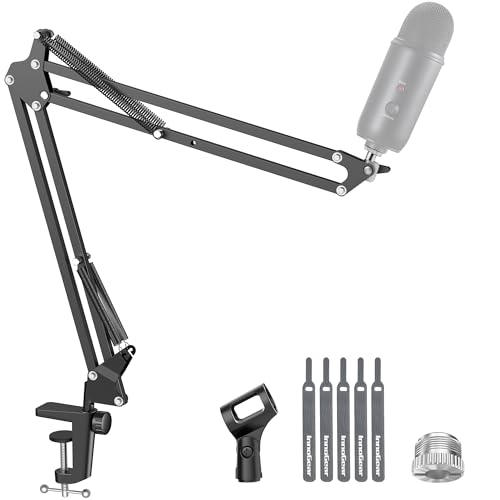
- ✓ Quiet operation
- ✓ Solid load capacity
- ✓ Flexible positioning
- ✕ Desk edge requirement
- ✕ Basic clamp design
| Load Capacity | 3.3 lb / 1.5 kg |
| Adjustment Range | 360° base rotation; 135° back and forth extension; 180° arm shaft movement; 270° microphone adapter rotation |
| Material & Build | Steel construction with reinforced springs |
| Desk Compatibility | Clamps to desk edges up to 2 inches thick |
| Microphone Compatibility (Adapters/Clips) | Standard 5/8″ microphone clip; 5/8″ to 3/8″ adapter included for Blue Yeti, Snowball, HyperX QuadCast, etc. |
| Included Hardware | Universal microphone clip; desk clamp; 5/8″ to 3/8″ adapter |
You’re setting up for a late-night voiceover session, and your desk is a tangle of cables and a mug halfway through a cold coffee. You grab the InnoGear Boom Arm, clamp it to a flat edge, and hear a quiet, confident latch snap into place.
The Yeti sits there, almost floating, with zero wobble as you nudge it to aim at your mouth. It feels like the kind of tool you forget you own until you need it most.
First thing you’ll notice is the motion: smooth, almost effortless, like gliding a bookmark along a spine. The 360° base rotation lets you spin without twisting the USB cable, and the 135° back-and-forth extension gives you enough range to keep your desk clear while you switch between takes.
The arm shaft moves 180° up and down, so you can raise or lower without re-clamping.
The build quality is solid without being heavy. It’s all steel, with springs that don’t slam or sag, even after a long session.
There’s a quiet confidence to the way the joints hold position, which matters when you’re chasing a clean take and don’t want micro-adjustments ruining your flow.
Setup is straightforward, and the desk clamp fits squared edges up to about 2 inches thick. If your edge is flat, you’ll be locking it in with minimal fuss.
The included microphone clip supports a wide range of mics, including Blue Yeti and Snowball variants, so you’re not hunting for adapters at 11 p.m.
In use, the subtlety matters most. It’s quiet, so you won’t pick up desk squeaks in your tracks.
The arm’s balance stays steady during quick repositioning, which is perfect for VO lines that require nuanced breathing and micro-pauses. Folding it away when you’re done keeps the space tidy for the next project.
Overall, it feels like a reliable, budget-friendly partner for daily voice work. It doesn’t pretend to be premium gear, but it earns its keep with quiet operation, solid load support, and flexible positioning you’ll actually use in real life.
If you’re balancing cost with practical performance, this arm is worth trying. It hits the sweet spot for home studios and small setups, especially when you need dependable, quick adjustments without disturbing the mic’s tone.
FIFINE BM88 Low Profile Microphone Boom Arm Stand for Gaming

- ✓ Sturdy all-metal build
- ✓ Low-profile, space-saving
- ✓ Clean cable management
- ✕ Limited near-clamp vertical adjust
- ✕ Desk clamp depth constraint
| Material | All-metal construction |
| Reach | Extends up to 29 inches |
| Rotation / Tilt Range | Vertical tilt up to 220°, horizontal rotation 360° |
| Mounting Compatibility | Desk clamp supports 0.8–2.4 in desk thickness; includes 1/4”, 3/8”, 5/8” thread adapters |
| Cable Management | Integrated internal cable management for neat routing |
| Included Accessories | Desk clamp, rotatable ball-head, allen wrench, user manual; two adapters pre-attached to ball-head |
You notice it the moment you pull the FIFINE BM88 out of the box: a solid, all-metal feel that immediately says “this stays put.” Compared to lighter arms I’ve tried, the BM88 doesn’t wobble when you yank the mic out to lean in during a tense moment in a game. The C-clamp grabs the desk with a quiet, confident grip, and you can tell it won’t scratch the surface after a few long sessions.
The low-profile design is a game changer if you’re space-conscious. It tucks under the monitor while still giving you full reach, so you don’t lose sight of the screen during an intense run.
When you adjust height or angle, the arm moves smoothly and holds its position, even at full extension. The 29-inch reach is real, enough to pull a mic in close for vocals and snap back for a quick shout during a match.
Cable management is exactly what you want when you’re streaming. Cables disappear along the arm, keeping the desk neat without tugging on the mic every time you posture or lean.
The three included screw adapters—1/4”, 3/8”, 5/8”—make setup painless, so you’re not hunting for a compatible mount after you’ve already unboxed it. One note: near the clamp, you don’t get vertical adjustability, so you’ll set that first and leave it.
In practice, this arm shines for gaming and voiceovers alike. It’s quiet, sturdy, and unobtrusive, letting you stay in frame and in character without fighting with your gear.
If you want a reliable, space-saving boom with solid build quality, the BM88 is worth your consideration.
What Features Make a Boom Arm Suitable for Voice Over?
When selecting the best quiet boom arm for voice over, several features are crucial for optimal performance.
- Noise Isolation: A boom arm designed for minimal noise transmission is essential, as it prevents vibrations from affecting the recording quality. Look for models that utilize rubber or foam padding to dampen sound and reduce any rattling during adjustments.
- Stability and Weight Capacity: A suitable boom arm should be sturdy enough to hold the microphone securely without sagging or tipping. Check the weight capacity to ensure it can support your microphone, especially if using heavier models.
- Adjustability: The ability to easily adjust the height and angle of the boom arm is important for achieving the best recording position. Look for arms with smooth pivot points and multiple locking adjustments to customize your setup effortlessly.
- Ease of Installation: A good boom arm should come with straightforward mounting options, allowing for quick and hassle-free installation. Models that include both desk clamps and mounting holes provide versatility for different setups.
- Durability: The construction materials of a boom arm can significantly impact its longevity and reliability. Aluminum or steel designs are preferable as they offer better strength and resistance to wear over time compared to plastic options.
- Compact Design: A boom arm that can fold or retract is beneficial for those with limited workspace. Compact options can help keep your recording area tidy and allow for easy storage when not in use.
- Cable Management: Integrated cable management features can help keep microphone cables organized and out of the way. This not only maintains a clean appearance but also reduces the risk of cable damage and tangling.
How Does Noise Isolation Impact Recording Quality?
Noise isolation plays a crucial role in enhancing the quality of voice recordings by minimizing unwanted sounds.
- Microphone Placement: Proper positioning of the microphone in relation to the sound source can significantly reduce background noise. Using a boom arm allows for flexible placement, ensuring that the microphone captures voice clearly while distancing it from noise sources such as traffic or air conditioning.
- Soundproofing Materials: Incorporating sound-absorbing materials in the recording environment can effectively dampen ambient sounds. These materials, such as foam panels or carpets, help to create a controlled space that allows for cleaner recordings without interference from external noise.
- Shock Mounts: Utilizing a shock mount with a boom arm helps to isolate the microphone from vibrations and handling noise. This is especially important in dynamic environments where even slight movements can introduce unwanted audio artifacts into the recording.
- Pop Filters: A pop filter is essential for reducing plosive sounds that can occur during speech. By placing a pop filter on the boom arm, it aids in noise isolation by preventing bursts of air from directly hitting the microphone, resulting in a smoother recording quality.
- Isolation Shields: An isolation shield can be integrated with a boom arm to provide additional sound isolation. These shields create a barrier around the microphone, further reducing the chances of capturing unwanted reflections or external noise, leading to a more professional sound.
What Weight Capacity Should a Boom Arm Have for Voice Over Equipment?
The weight capacity of a boom arm for voice over equipment is crucial to ensure stability and functionality, especially with various microphones and accessories. Here are some key factors to consider:
- Microphone Weight: The boom arm should be able to support the weight of your microphone, typically ranging from 0.5 lbs to 3 lbs.
- Additional Accessories: Consider the weight of any additional equipment such as pop filters, shock mounts, and windshields that may be attached to the microphone.
- Adjustability and Stability: A boom arm with a higher weight capacity often has better adjustability and stability, allowing for a more versatile setup.
- Material Quality: The construction material of the boom arm affects its weight capacity; aluminum or steel arms tend to support more weight compared to plastic ones.
- Usage Environment: If the boom arm will be used in a professional studio or home setup, consider a higher weight capacity to accommodate various setups and ensure durability.
Microphone Weight: It’s important to check the specific weight of your microphone, as some professional microphones can be heavier. A boom arm should accommodate this weight without sagging, ensuring that your audio quality remains consistent and clear.
Additional Accessories: If you plan to use accessories, their combined weight should not exceed the boom arm’s capacity. This includes pop filters and shock mounts, which can add extra load and affect the arm’s stability.
Adjustability and Stability: Boom arms with a higher weight capacity often come with better adjustability features, allowing you to position your microphone precisely where you need it. This is especially important for voice over work where microphone placement can significantly impact sound quality.
Material Quality: The material of the boom arm plays a significant role in its durability and weight capacity. High-quality materials like aluminum or steel can withstand heavier loads and provide a more stable setup than cheaper plastic alternatives.
Usage Environment: Consider where you will be using the boom arm; professional environments often demand higher standards for stability and weight capacity due to more complex setups. A robust boom arm can better handle the rigors of frequent adjustments and use.
Which Quiet Boom Arms Are Highly Rated for Voice Over?
The best quiet boom arms for voice over are designed to minimize noise and provide stability for vocal recording.
- Heil Sound PL-2T: This boom arm is known for its durability and quiet operation, featuring a unique design that eliminates unwanted noise during recordings.
- Rode PSA1: The PSA1 is highly regarded for its smooth movement and adjustable tension, allowing for precise positioning without causing vibrations or noise.
- Gator Frameworks GFW-BTA-4000: This boom arm provides excellent stability and a sleek design, making it a popular choice among voice-over artists looking for a quiet and reliable option.
- Blue Microphones Compass: The Compass boasts a professional-grade design that minimizes handling noise and offers flexible positioning, ideal for voice recording environments.
- InnoGear Microphone Suspension Boom Arm: This budget-friendly option is surprisingly effective at isolating sound, with a sturdy build that can handle heavier microphones without creaking.
The Heil Sound PL-2T is an exceptional choice for those seeking a reliable boom arm that effectively reduces noise. Its sturdy construction and thoughtful design ensure that it remains silent during use, making it perfect for voice-over applications.
The Rode PSA1 stands out due to its adjustable spring tension and 360-degree rotation capabilities, allowing voice-over artists to position their microphones exactly where needed without the risk of noise interference from movement.
The Gator Frameworks GFW-BTA-4000 is engineered with stability in mind, featuring a robust design that supports microphones securely while minimizing vibrations, ensuring clean audio captures during recording sessions.
The Blue Microphones Compass is recognized for its high-quality build and aesthetic appeal, offering smooth articulation and minimal handling noise, making it an excellent choice for professional voice-over work.
For those on a budget, the InnoGear Microphone Suspension Boom Arm provides solid performance at an affordable price, effectively isolating sound and preventing unwanted noise, making it suitable for aspiring voice-over artists.
What Stabilization Features Should You Consider in a Boom Arm?
When selecting the best quiet boom arm for voice over work, several stabilization features are essential to ensure optimal performance.
- Weight Capacity: The weight capacity of a boom arm determines how much equipment it can support without sagging or losing stability. A higher weight capacity allows for the use of heavier microphones and accessories without compromising the arm’s integrity, which is crucial for maintaining sound quality during recordings.
- Joint Locking Mechanism: A reliable joint locking mechanism is vital for securing the arm in place once it has been positioned. This feature prevents unwanted movement or drooping, ensuring that the microphone remains stable and at the desired angle during voice over sessions.
- Adjustable Tension: Boom arms with adjustable tension allow users to customize the resistance of the arm’s movement. This flexibility is important for achieving smooth, controlled adjustments while also preventing sudden drops or shifts that could disrupt recording quality.
- Shock Mount Compatibility: Compatibility with shock mounts is an important consideration, as these devices help isolate the microphone from vibrations and handling noise. A boom arm that accommodates shock mounts can significantly improve audio clarity, especially in environments where external noise or vibrations are a concern.
- Base Stability: The stability of the boom arm’s base plays a critical role in preventing tipping or wobbling. A wider base or a heavier design can enhance stability, ensuring that the arm remains securely in place during use without contributing to unwanted noise in recordings.
- Cable Management: Effective cable management features help organize and secure microphone cables along the boom arm. This not only reduces clutter but also minimizes the risk of accidental pulls or snags, which can disrupt recordings and reduce overall audio quality.
How Do Noise Levels Vary Among Popular Boom Arms?
Noise levels among popular boom arms can significantly affect the quality of voice-over recordings.
- Rode PSA1: This boom arm is known for its quiet operation due to its internal spring design, which minimizes noise during adjustments.
- Heil Sound PL-2T: The PL-2T features a robust build that reduces vibrations and noise, making it ideal for voice-over work in quiet environments.
- Blue Microphones Compass: The Compass boom arm employs a unique internal tension system that minimizes noise while maintaining flexibility for positioning.
- Gator Frameworks GFW-MIC-0821: This model is designed with heavy-duty materials that dampen sound transmission, ensuring a quieter setup for recording.
- Elgato Wave Mic Arm: The Wave Mic Arm incorporates a shock mount and is built to reduce handling noise, making it particularly effective for voice-over professionals.
The Rode PSA1 is favored for its quiet operation, which is achieved through an internal spring mechanism that allows for smooth adjustments without generating noise. This feature is particularly beneficial in voice-over settings where clarity and precision are paramount.
The Heil Sound PL-2T is engineered to minimize unwanted vibrations and noise, thanks to its sturdy construction. This boom arm is excellent for maintaining the integrity of audio recordings, as it isolates the microphone from external noise sources.
The Blue Microphones Compass sets itself apart with its internal tension system, which allows for effortless positioning while keeping noise levels low. This makes it a versatile option for voice-over artists who need to adjust their mic frequently without disrupting their recording sessions.
The Gator Frameworks GFW-MIC-0821 features a design that effectively dampens sound transmission, making it a reliable choice for those requiring a quiet recording environment. Its heavy-duty build also ensures stability, which helps in reducing any accidental noise from movements.
The Elgato Wave Mic Arm is specifically tailored for content creators, featuring a built-in shock mount that absorbs handling noise effectively. This design is particularly advantageous for voice-over work, as it allows for the freedom of movement without compromising sound quality.
How Can a Quiet Boom Arm Enhance Your Voice Over Experience?
Space efficiency is essential, especially in small recording environments. A boom arm keeps the microphone off the desk, which not only declutters your workspace but also reduces the risk of accidental knocks that could create unwanted noise in your recordings.
Durability is an important factor to consider when selecting a boom arm, as it should be able to withstand regular adjustments and the weight of your microphone. A robust boom arm will ensure longevity and reliability, essential for consistent voice-over work.
Compatibility with various microphones and accessories means that a quiet boom arm can be a valuable addition to any setup. Whether you’re using a standard dynamic mic or a more sensitive condenser mic, a versatile boom arm can help you achieve the desired sound quality without needing to invest in multiple stands.
What Is the Typical Price Range for Quality Quiet Boom Arms?
Benefits of using a quality quiet boom arm include improved sound quality, increased flexibility during recording sessions, and the potential for enhanced workflow efficiency. By easily adjusting the microphone’s position, voice-over artists can focus more on performance rather than technicalities, leading to a better final product. Furthermore, some boom arms offer features like integrated cable management, which helps keep workspaces tidy and reduces the risk of audio interference.
To maximize the effectiveness of a boom arm, best practices include ensuring proper installation and adjustment to accommodate the specific microphone being used. Regular maintenance, such as checking for loose screws and keeping joints lubricated, can extend the lifespan of the equipment. Additionally, pairing a quality boom arm with other audio accessories, like shock mounts and pop filters, can further enhance recording quality by addressing various noise issues.
How Should You Mount a Boom Arm for the Best Performance?
To achieve the best performance from a boom arm for voice over work, consider the following key aspects:
- Positioning: Properly positioning your boom arm can greatly influence sound quality and comfort during recording sessions.
- Stability: Ensuring that the boom arm is securely mounted helps prevent unwanted vibrations and noise from affecting your recordings.
- Adjustment Options: Look for boom arms that allow for easy adjustments to height and angle, providing flexibility in your recording setup.
- Weight Capacity: Choosing a boom arm with adequate weight capacity ensures it can support your microphone without sagging or moving during use.
- Shock Mount Compatibility: Utilizing a shock mount with your boom arm can further reduce vibrations and handling noise, leading to clearer audio.
Positioning your boom arm correctly involves placing it at an optimal distance from your mouth while ensuring that it doesn’t block your line of sight or create an awkward working environment. Aim for a height that allows you to speak into the microphone comfortably while maintaining a natural posture.
Stability is crucial; a securely mounted boom arm will prevent it from shifting or vibrating, which can introduce unwanted noise into your recordings. Utilize a sturdy desk clamp or wall mount, and ensure that all screws and joints are tightened to minimize movement.
Adjustment options are important for adapting the boom arm to various recording situations. A boom arm that can easily adjust in height and angle allows you to find the perfect position quickly, which is especially useful during longer recording sessions.
When considering weight capacity, ensure that the boom arm can easily support your microphone without drooping or moving. This is particularly important for heavier microphones that could cause less sturdy arms to bend or fail.
Using a shock mount in conjunction with your boom arm helps isolate the microphone from vibrations and handling noise, which can significantly improve audio clarity. A good shock mount absorbs shocks and bumps, making it an essential accessory for voice over work.
Related Post: