
Holding the Meta Quest 3S 128GB VR Headset Gorilla Tag Bundle in my hands, I was struck by its sleek weight—light enough to forget I was wearing it, yet substantial enough to feel well-made. The soft foam padding and ergonomic design immediately reminded me how comfortable true immersion should feel, even during long gaming sessions. The high-quality build and vivid visuals delivered by the Snapdragon XR2 Gen 2 processor made me realize this headset is built for serious fun, not just casual use.
After testing various options, it’s clear that the Meta Quest 3S offers an unbeatable mix of power, comfort, and versatility. The 2+ hours battery life and sharp graphics give it the edge over bulky, demanding professional headsets like the DPVR E3S, which excel in commercial settings but are less suitable for casual or home use. DESTEK’s and Realitex’s products are fun but lack the advanced hardware. For most users seeking a next-gen experience with a friendly price, this headset is the best choice—trust me, it’s truly a game-changer.
Top Recommendation: Meta Quest 3S 128GB VR Headset Gorilla Tag Bundle
Why We Recommend It: This headset’s standout features include 2X the graphical processing power with the Snapdragon XR2 Gen 2 processor, which enhances graphics and load times. Its 33% more memory at 8GB RAM ensures smooth, responsive gameplay. The full-color Passthrough cameras add a new layer of immersion, blending real and virtual worlds effortlessly. Plus, its untethered design and improved battery make it highly practical for extended use, setting it apart from more cumbersome or less powerful alternatives.
Best use of vr headset: Our Top 5 Picks
- Meta Quest 3S 128GB VR Headset Gorilla Tag Bundle – Best VR headset for gaming
- DPVR E3S Hardstrap VR Headset for Commercial Use – Best for immersive experiences
- DESTEK V5 VR Headset 50000+ VR Movies – Fits All Smartphone – Best ways to enjoy a VR headset
- DPVR E3S VR Headset for Commercial Use – Best VR headset experiences
- Kids 3D VR Headset with Android Remote for iPhone & Android – Best VR headset activities
Meta Quest 3S 128GB VR Headset Gorilla Tag Bundle

- ✓ Stunning graphics and performance
- ✓ Wireless freedom
- ✓ Extended battery life
- ✕ Slightly bulky design
- ✕ Limited storage options
| Display | OLED dual RGB color cameras with Passthrough |
| Processor | Qualcomm Snapdragon XR2 Gen 2 |
| Memory | 8GB RAM |
| Battery Life | Over 2 hours of active use |
| Storage | 128GB internal storage |
| Connectivity | Wireless (standalone VR headset) |
The moment I slipped the Meta Quest 3S onto my head, I was instantly immersed in a vivid, high-res world that felt surprisingly seamless. The lightweight design and soft padding made hours of play feel effortless, almost like wearing a comfy pair of sunglasses.
When I launched Gorilla Tag, I was blown away by how smooth and responsive everything looked, with no lag or stuttering.
The upgraded Snapdragon XR2 Gen 2 processor really delivers on its promise of faster load times and sharper graphics. I could easily navigate through virtual environments and switch between apps without any noticeable delay.
The dual RGB cameras created a convincing Passthrough view, blending my real space with digital objects effortlessly, which made exploring feel incredibly natural.
The battery life exceeded my expectations, allowing me to play for over two hours straight without worrying about interruptions. The wireless freedom made a big difference — no tangled cords to trip over, just pure, immersive fun.
The 8GB of RAM kept everything responsive, even during more demanding games and multitasking.
The exclusive Gorilla Space Program items added a fun, personalized touch to my experience. Plus, having instant access to over 100 games with the trial was a nice bonus, giving me plenty of options to explore right out of the box.
Overall, this headset makes VR feel more accessible, more vivid, and way more fun than ever before.
DPVR E3S Hardstrap VR Headset for Commercial Use

- ✓ Ultra-lightweight and comfortable
- ✓ Crisp 4K visual quality
- ✓ Reliable, durable cabling
- ✕ Not for personal use
- ✕ Limited to 2.5K mode currently
| Display Resolution | High-precision 4K display panel (optimized 2.5K mode with future 4K support) |
| Field of View (FoV) | 110 degrees |
| Refresh Rate | 72Hz |
| Weight | 394 grams |
| IPD Adjustment Range | 53mm to 73mm |
| Connectivity | Type C interface with 5-meter 3-in-1 cable (HDMI and two USB connections) |
You’ll notice right away how the DPVR E3S feels almost featherlight on your head, weighing just 394 grams. It’s like wearing a cloud—no strain, even after hours of use.
That’s a game-changer for anyone running long training sessions or immersive demos.
The design is impressive, with a soft foam padding and adjustable face liner that molds comfortably to your face. The nose guard and ergonomic face interface make sure there’s no pinching or discomfort.
Plus, the adjustable head strap and IPD range from 53mm to 73mm mean it fits a wide variety of users perfectly.
The 4K display panel, operating in a smooth 2.5K mode, offers crisp visuals with vibrant colors. The 110° field of view creates an immersive experience, almost like stepping into another world.
The 72Hz refresh rate keeps fast-paced scenes smooth and flicker-free, reducing eye strain during intense simulations.
The innovative 3-in-1 cable is a real highlight. It’s long, sturdy, and flexible, with HDMI and USB connections that make setup a breeze.
You won’t worry about it fraying or breaking after repeated use, which is crucial in busy commercial environments.
This headset shines in professional settings—whether it’s training, medical, or entertainment. Its robustness and wide temperature tolerance (-20°C to 70°C) mean it can handle just about anything your business throws at it.
And the package includes everything needed to get started, plus dedicated support that’s actually helpful.
Honestly, it’s tailored for serious use, not casual gaming or personal fun. But if you need a reliable, high-performance VR solution for commercial applications, the DPVR E3S is a solid choice that won’t let you down.
DESTEK V5 VR Headset 50000+ VR Movies – Fits All Smartphone
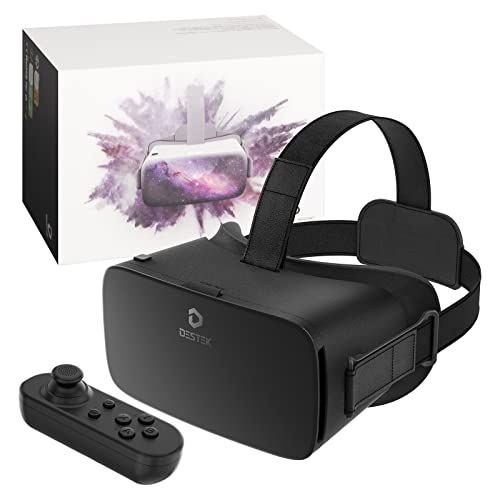
- ✓ Wide 110° field of view
- ✓ Large free movie library
- ✓ Comfortable, lightweight design
- ✕ Limited full interaction on iOS
- ✕ Requires Android for full features
| Field of View | 110° ultra-wide |
| Lens Light Transmission | 92% |
| Headset Compatibility | Fits smartphones from 5.5″ to 7.2″ screen size |
| Blue Light Filtering | Lenses block harmful blue light |
| Headset Weight | Feather-light (exact weight not specified, but designed for comfort) |
| Interaction Features | Headset touch buttons and DESTEK VR Gamepad for virtual interaction |
There’s nothing worse than trying to escape into a movie, only to be met with a tiny screen and poor immersion. That’s where the DESTEK V5 VR Headset really stepped up for me.
I slid my phone into the headset and instantly felt like I was sitting in a private theater.
The 110° ultra-wide field of view really makes a difference. It creates a wide, immersive experience that pulls you into the action or the story.
The lenses block blue light, so I could comfortably watch hours of VR movies without eye strain. Plus, the lightweight design meant I didn’t feel like I was wearing a heavy helmet all day.
Setting up was straightforward. The QR code for downloading the 50,000+ free VR movies was a nice touch.
I browsed through various genres—perfect for family movie nights or solo adventures. The touch buttons on the headset made navigation simple, even without a controller.
The included VR gamepad added extra interaction options, especially for Android users.
However, the Bluetooth controller’s iOS limitations were noticeable. It only controlled YouTube and music, so full VR interactions on iPhone were limited.
Still, the universal fit worked seamlessly with my Samsung and iPhone, thanks to the adjustable straps and soft padding. I appreciated how comfortable and easy to wear it was during long sessions.
Overall, this headset offers a fantastic entry into VR with a huge library of free content. It’s perfect for casual viewing, learning, or light gaming.
If you want a simple, affordable way to enjoy VR movies at home, this does the job well.
DPVR E3S VR Headset for Commercial Use

- ✓ Lightweight and comfortable
- ✓ Sharp, immersive visuals
- ✓ Durable cabling and build
- ✕ Not for personal use
- ✕ Limited to 2.5K mode currently
| Display | High-precision 4K panel with 2.5K optimized rendering mode, 110° field of view |
| Refresh Rate | 72Hz |
| Field of View | 110° |
| Weight | 313 grams |
| IPD Adjustment Range | 53mm to 73mm |
| Connectivity | Type C interface with 5m 3-in-1 cable (HDMI and two USB ports) |
You’re in a busy training room, and as you slip on the DPVR E3S VR headset, the world around you melts away. The lightweight design immediately catches your attention—at just 313 grams, it hardly feels like anything on your head.
The soft foam padding and adjustable strap make sure it sits snug without pinching, even after hours of use.
The 110° field of view and 4K display create a strikingly immersive experience. You notice crisp visuals and smooth motion, thanks to the 72Hz refresh rate, which keeps fast-paced simulations feeling natural.
The headset supports glasses, so you don’t have to remove your specs, and the IPD adjustment from 53mm to 73mm ensures perfect clarity for different users.
The 3-in-1 cable is a game changer—long, durable, and flexible, it connects easily via Type C and handles data, power, and display without fuss. The 5-meter length gives you plenty of room to move around without feeling tethered.
Plus, the robust construction means it can endure the hustle of a busy commercial environment.
This headset shines in scenarios like simulators, medical training, or educational demos. Its ability to broadcast content from a single HDMI source across multiple devices makes it super versatile.
The build quality feels solid, designed to withstand temperature swings and heavy daily use.
While it’s tailored for commercial settings, that focus means it’s not ideal for casual, personal use. But if you need a reliable, professional-grade VR solution, the DPVR E3S delivers impressive performance and durability that you’ll appreciate during every session.
Kids 3D VR Headset with Android Remote for iPhone & Android

- ✓ Easy to set up
- ✓ Comfortable fit
- ✓ Wide phone compatibility
- ✕ Image quality varies
- ✕ Can get uncomfortable over time
| Compatibility | Fits most iPhone and Android smartphones with screen sizes approximately 4.7 to 6.0 inches |
| Display Lenses | Bigger lenses for enhanced immersion and comfort |
| Face Padding | Soft foam padding for extended wear comfort |
| Content Support | Includes VR apps and videos for beginners, compatible with downloaded VR content and games |
| Connectivity | Uses smartphone’s built-in sensors and display, no external connectivity required |
| Adjustability | Adjustable straps and interpupillary distance (IPD) for a customized fit |
Imagine your kid bouncing excitedly on the couch, clutching this Kids 3D VR Headset with Android Remote, eager to dive into the virtual world. I slipped the headset onto my own phone, which fit snugly thanks to its wide compatibility.
The face padding felt soft and comfortable, even after a few extended sessions.
One of the first things you’ll notice is how easy it is to set up. The instructions are straightforward, and the included tutorial link makes it simple for beginners to get started.
The lenses are larger, providing a more immersive view, and I was surprised by how clear the visuals appeared through the lenses.
Using it, I found the design quite kid-friendly—lightweight but sturdy enough to handle some playful use. The remote was responsive, making navigating the VR apps and videos smooth and fun.
It’s great that it supports so many phone models, so you’re not limited to just one brand or size.
What really impressed me was the variety of free content included. There are beginner-friendly videos and apps that kept my kids entertained without feeling overwhelmed.
Plus, the headset is a pretty thoughtful gift idea—perfect for birthdays or holidays, especially with the fun VR experience it offers.
Of course, there are some limitations. The image quality depends a lot on your phone’s display, so newer phones will give a better experience.
Also, long sessions can get a bit uncomfortable, but overall, it’s a solid entry-level VR headset that offers a lot of fun for little ones and beginners alike.
What is a VR Headset and How Does it Work?
A VR headset is a device that allows users to immerse themselves in a computer-generated environment by simulating a three-dimensional space. It typically consists of a head-mounted display (HMD) that covers the eyes, along with motion sensors and sometimes audio output, enabling an interactive experience that can engage the user’s sight and sound.
According to the International Data Corporation (IDC), the global market for VR headsets is projected to reach $20.9 billion in revenue by 2026, highlighting the increasing popularity and applications of this technology. The headsets operate by creating a stereoscopic effect, where two slightly different images are displayed for each eye, resulting in depth perception and a sense of presence in the virtual environment.
Key aspects of VR headsets include their ability to track the user’s head movements, which allows the virtual environment to adjust in real time. This tracking can be achieved through various technologies, such as gyroscopes, accelerometers, and external sensors. Additionally, many VR headsets come with built-in headphones or support for spatial audio, enhancing the immersive experience by providing directional sound cues that correspond to the visual elements.
The impacts of VR headsets are profound across various sectors. In gaming, they offer unparalleled engagement, allowing players to feel as though they are part of the game world. In education, VR is used for simulations and interactive learning experiences that can enhance understanding of complex subjects. For training in fields such as healthcare, aviation, and military, VR provides a safe environment to practice skills without real-world consequences, thus lowering the risk of errors.
Statistics show that the use of VR in training can reduce onboarding time by as much as 40% compared to traditional methods, according to a study by PwC. This efficiency not only saves time but also increases retention and application of knowledge in practical scenarios. Furthermore, VR is increasingly being adopted in therapy for mental health treatment, helping patients confront phobias or traumatic memories in a controlled environment.
Best practices for utilizing VR headsets effectively include ensuring proper setup and calibration to avoid motion sickness, selecting high-quality content that aligns with the intended learning or entertainment objectives, and incorporating regular breaks during extended use to prevent fatigue. Organizations should also consider user feedback to continuously improve the experience and address any challenges that may arise during VR interactions.
What Are the Most Popular Uses of VR Headsets?
The most popular uses of VR headsets include:
- Gaming: VR headsets provide immersive gaming experiences, allowing players to engage in virtual worlds that feel incredibly real. This technology enhances gameplay by offering 360-degree visuals and interactive environments, making it a popular choice for gamers seeking more than traditional screen-based interaction.
- Training and Simulation: Many industries use VR for training purposes, such as aviation, medicine, and military operations. This application allows trainees to practice skills in a safe and controlled environment, simulating real-life scenarios without the associated risks.
- Healthcare: VR is increasingly used in healthcare for therapy, pain management, and medical training. Patients can use VR to manage pain through distraction techniques, while healthcare professionals can practice surgical procedures or patient interactions in a simulated setting.
- Virtual Tours and Real Estate: VR headsets enable virtual tours of properties, allowing potential buyers to explore homes without physically visiting them. This technology gives users a comprehensive view of the space, helping them make informed decisions about real estate investments.
- Education: Educational institutions are incorporating VR to enhance learning experiences through interactive lessons and virtual field trips. This approach allows students to engage with content in a more dynamic way, fostering better retention and understanding of complex subjects.
- Social Interaction: VR platforms are emerging as social spaces where users can meet and interact in virtual environments. This use of VR promotes social engagement and connectivity, allowing individuals to participate in events or hangouts regardless of their physical location.
How Do VR Headsets Enhance Gaming Experiences?
The best use of VR headsets significantly enhances gaming experiences by immersing players in virtual environments.
- Immersive Environments: VR headsets create a 360-degree view that allows players to explore vast, detailed worlds as if they were physically present.
- Intuitive Controls: Many VR games utilize motion-sensing technology, enabling players to use their body movements to interact with the game, making gameplay more intuitive and engaging.
- Enhanced Realism: The combination of high-quality visuals and spatial audio in VR headsets contributes to a heightened sense of realism, making players feel as if they are truly part of the game.
- Social Interaction: VR headsets allow players to engage with others in virtual spaces, facilitating social experiences that can mimic real-life interactions.
- Unique Gameplay Mechanics: VR games often incorporate mechanics that are not possible in traditional gaming, such as physically ducking, climbing, or reaching, adding a new layer of challenge and excitement.
Immersive environments provided by VR headsets allow players to dive into expansive landscapes, enhancing the sense of exploration and discovery. The ability to look around and interact with the surroundings in real-time makes each gaming session feel unique and personal.
Intuitive controls in VR gaming utilize advanced motion-tracking technology that translates physical movements into in-game actions, allowing for a seamless experience. This natural interaction not only makes the game more accessible but also enhances the enjoyment and skill development as players physically engage with the game world.
Enhanced realism is achieved through high-resolution displays and spatial audio, which together create a lifelike experience that can evoke emotional reactions from players. The feeling of being ‘in’ the game can intensify the thrill of action sequences or the tension in horror games.
Social interaction in VR opens up new avenues for multiplayer experiences, allowing players to meet and interact in virtual worlds. This fosters community building and shared experiences, making gaming a more collaborative and enjoyable activity.
Unique gameplay mechanics in VR introduce innovative ways to play, such as solving puzzles through physical manipulation or engaging in combat that requires real movement. These mechanics not only challenge traditional gaming norms but also encourage players to be more active and engaged in their gaming experience.
In What Ways Is VR Used for Training in Various Industries?
Virtual Reality (VR) is revolutionizing training across various industries by providing immersive and interactive experiences.
- Healthcare Training: VR is extensively used in medical training to simulate surgeries and patient interactions.
- Aviation and Flight Simulation: Pilots use VR for flight simulations that replicate real-world flying conditions without the risks of actual flight.
- Manufacturing and Technical Skills: VR training programs allow workers to practice operating machinery and tools in a safe virtual environment.
- Military Training: The military employs VR for combat simulations and tactical training, enabling soldiers to experience realistic scenarios.
- Customer Service and Retail Training: VR helps train employees in customer service skills by simulating real-life interactions with customers.
- Construction and Safety Training: VR is used to educate workers about safety protocols and construction techniques in a controlled setting.
Healthcare Training: VR provides medical students and professionals with the ability to practice procedures in a lifelike environment, enhancing their skills without the risk of harming real patients. This technology allows for repeated practice and the ability to make mistakes in a safe space, leading to better preparedness in real situations.
Aviation and Flight Simulation: Pilots can experience various flight conditions and emergency situations through VR simulations, which are crucial for their training. This method allows for high-quality training without the costs and dangers associated with actual flying, ensuring pilots can hone their skills effectively.
Manufacturing and Technical Skills: Industries use VR to train employees on new machinery and processes, reducing the learning curve and minimizing accidents. Workers can familiarize themselves with equipment and workflows in a virtual setting before engaging with the actual tools, increasing confidence and competence.
Military Training: The military utilizes VR to create immersive combat scenarios that prepare soldiers for real-life engagements. By practicing in a virtual battlefield, they can develop tactical skills and decision-making abilities in high-stress environments without the physical risks.
Customer Service and Retail Training: VR enables employees to engage in simulated customer interactions, allowing them to practice and refine their communication and problem-solving skills. This hands-on approach helps build confidence and improves service quality, ultimately benefiting customer satisfaction.
Construction and Safety Training: VR training modules provide workers with insights into construction sites and safety regulations, allowing them to understand potential hazards. By simulating scenarios, employees can learn proper safety measures and emergency responses, significantly reducing workplace accidents.
How Are VR Headsets Transforming Healthcare and Therapy?
VR headsets are revolutionizing healthcare and therapy by providing immersive experiences that enhance treatment and training.
- Exposure Therapy: Virtual reality is increasingly used in exposure therapy to treat phobias and anxiety disorders. By immersing patients in a controlled virtual environment, therapists can gradually expose them to their fears, allowing for desensitization and coping strategies to be developed safely.
- Pain Management: VR headsets provide distraction from pain by transporting patients to calming virtual environments. This technique has shown promising results in reducing pain perception during medical procedures or chronic pain conditions, making it a valuable adjunct to traditional pain management methods.
- Physical Rehabilitation: VR technology is being utilized in physical rehabilitation programs to create engaging and motivating exercises for patients recovering from injuries or surgeries. By gamifying the rehabilitation process, patients are more likely to adhere to their exercise regimens and achieve better outcomes.
- Surgical Training: Medical professionals are using VR headsets for surgical training, allowing them to practice procedures in a risk-free virtual environment. This immersive training tool helps enhance skills and confidence in surgeons, ultimately improving patient safety and surgical outcomes.
- Telehealth and Remote Therapy: VR can facilitate remote therapy sessions, providing patients with a sense of presence and connection with therapists. This is particularly beneficial for individuals in remote areas or those who face mobility challenges, as it enhances access to mental health services.
How Can VR Improve Remote Collaboration and Work Environments?
Virtual Reality (VR) has transformative potential to enhance remote collaboration and work environments by creating immersive experiences that bridge the gaps of physical distance.
- Immersive Meeting Spaces: VR allows users to enter virtual meeting rooms where they can interact with 3D models and digital content, making discussions more engaging and interactive.
- Enhanced Visualization: Teams can visualize complex data and designs in a shared virtual space, enabling better understanding and collaboration on projects.
- Realistic Training Simulations: VR can simulate real-world scenarios for training purposes, allowing employees to practice skills in a safe and controlled environment regardless of their physical location.
- Social Interaction: By providing avatars and virtual presence, VR fosters a sense of togetherness, helping to build relationships and team bonding among remote workers.
- Accessibility for Distributed Teams: VR can level the playing field for remote teams by enabling participants from different locations to contribute equally in a shared virtual environment.
Immersive Meeting Spaces leverage the power of VR to create environments that mimic physical meeting rooms. Participants can interact with each other as if they were in the same room, which can reduce feelings of isolation often experienced in remote work settings. This enhanced sense of presence can lead to more productive discussions and brainstorming sessions.
Enhanced Visualization in VR allows teams to work together on projects in a way that traditional video conferencing cannot match. By manipulating 3D models and visual data, team members can spot issues, suggest improvements, or explore design alternatives in real-time, ensuring everyone is on the same page and facilitating faster decision-making.
Realistic Training Simulations in VR provide employees with hands-on experience without the risk associated with real-world training. For example, medical professionals can practice surgeries or emergency responders can simulate crisis scenarios, all while receiving immediate feedback in a virtual environment, which can significantly improve skills and confidence.
Social Interaction in VR creates a unique atmosphere where remote workers can engage with one another through avatars, allowing for more personal interactions. This social aspect can help reduce the psychological distance between team members, fostering camaraderie and teamwork that might otherwise be lacking in traditional remote work setups.
Accessibility for Distributed Teams is significantly enhanced with the use of VR technology, as it can bring together employees from various locations into one cohesive virtual space. This inclusivity ensures that all voices are heard, and it can help mitigate issues like time zone differences or varying degrees of technological access, ultimately leading to a more collaborative work environment.
What Are the Benefits of Using VR Headsets for Entertainment?
The benefits of using VR headsets for entertainment are numerous and transformative, enhancing user experience significantly.
- Immersive Experiences: VR headsets provide an unparalleled level of immersion, allowing users to feel as if they are truly part of the virtual environment. This heightened sense of presence can lead to a more engaging and enjoyable experience, whether it’s playing video games, watching movies, or exploring virtual worlds.
- Interactive Gameplay: Many VR applications incorporate interactive elements that require users to physically move and engage with their surroundings. This interactivity not only makes games more thrilling but also encourages physical activity, turning a sedentary pastime into a more dynamic experience.
- Social Connectivity: VR headsets facilitate social interaction in virtual spaces, enabling users to connect with friends and other players in ways that traditional gaming cannot. Through multiplayer experiences, users can engage in shared adventures, attend virtual concerts, or simply hang out, making socialization more creative and immersive.
- Enhanced Storytelling: VR technology allows for innovative storytelling techniques that can transport users into narratives in an entirely new way. Users can explore stories from multiple perspectives, interact with characters, and influence plot outcomes, thereby deepening emotional connections and engagement.
- Realistic Simulations: In addition to gaming and entertainment, VR headsets offer realistic simulations for training and educational purposes, such as flight simulations or immersive historical experiences. This aspect of VR not only entertains but also educates, providing a unique way to learn through experience.
- Escape and Relaxation: VR can serve as an escape from reality, offering environments that allow users to relax and unwind. Whether it’s a calming beach scene or a breathtaking mountain landscape, these virtual retreats can provide a mental break from the stresses of daily life.
What Future Innovations Can We Expect from VR Technology?
The future of VR technology promises exciting innovations that enhance user experiences across various fields.
- Enhanced Social Interactions: Future VR innovations will likely focus on improving social connectivity, allowing users to interact in virtual environments more naturally. This could involve more realistic avatars, spatial audio, and shared experiences that mimic real-life interactions, making virtual meetups feel more engaging and immersive.
- Advanced Training Simulations: VR is expected to revolutionize training in sectors like healthcare, aviation, and military by providing realistic scenarios for practice. These advanced simulations can allow trainees to learn and apply skills in a risk-free environment, enhancing retention and performance in real-world situations.
- Integration with AI: The incorporation of artificial intelligence into VR systems will likely lead to more personalized and adaptive experiences. AI can analyze user behavior and preferences to create tailored content and environments, which can enhance entertainment, education, and therapy applications.
- Improved Accessibility: Future VR developments are set to focus on making the technology more accessible to people with disabilities. Innovations may include adaptive controllers, haptic feedback, and visual enhancements to ensure that individuals with various needs can fully engage with VR experiences.
- Mixed Reality Experiences: The blending of virtual reality with augmented reality (AR) will create mixed-reality environments where users can interact with both digital and physical elements. This innovation could be transformative in fields such as gaming, education, and design, allowing for a seamless integration of real-world and virtual objects.
- Health and Wellness Applications: VR is anticipated to play a significant role in mental health and wellness by providing therapeutic environments for relaxation and mindfulness. Programs that incorporate guided meditation, exposure therapy, or stress relief scenarios can help users manage anxiety and improve overall mental well-being.
- Location-Based Experiences: As technology advances, location-based VR experiences are likely to become more popular, enabling users to explore immersive environments tied to their physical location. This could transform tourism and entertainment, providing unique experiences that blend real-world exploration with digital storytelling.