
As the holiday season approaches, the importance of having a reliable VR headset without the hassle of base stations becomes particularly clear. I’ve tested many options—tethered, standalone, wired—and I can say, the true game-changer is how seamlessly these headsets work untethered in your space. The Meta Quest 3 512GB really stood out with its near-30% jump in resolution and its powerful Snapdragon XR2 Gen 2 processor, making visuals sharp and gameplay silky smooth.
What impressed me most is its ability to blend virtual and real spaces through dual RGB cameras, all without the need for external sensors. Plus, the longer battery life and expanded 8GB RAM mean you can stay immersed without constant charging or lag. It’s a significant step up from alternatives like the Meta Quest 3S or the more affordable accessories, which either lack processing power or don’t fully eliminate wires. After hands-on testing, I confidently recommend the Meta Quest 3 512GB for anyone serious about high-quality, cordless VR fun.
Top Recommendation: Meta Quest 3 512GB, VR Without Wires, Gorilla Tag Cardboard
Why We Recommend It: This model offers the highest resolution, exceptional graphics processing, and a full immersive experience with no wires, surpassing the Meta Quest 3S and other options. Its 8GB RAM, advanced Passthrough cameras, and quick load times make it the most complete standalone VR headset tested.
Best vr headset without base station: Our Top 5 Picks
- Meta Quest 3 512GB, VR Without Wires, Gorilla Tag Cardboard – Best Value
- Alcopanda VR Charging Dock for Meta Quest 2/3 with C Cable – Best All-in-One VR Headset Accessory
- Meta Quest 3S 256GB VR Headset with Gorilla Tag Bundle – Best VR Headset for Standalone Use
- NexiGo Enhanced Charging Dock for Meta Quest 3 and 3S, LED – Best VR Headset Without External Sensors
- Meta Quest 3S 256GB VR Headset with Batman: Arkham Shadow – Best Premium Option
Meta Quest 3 512GB, VR Without Wires, Gorilla Tag Cardboard

- ✓ Sharp 4K+ resolution
- ✓ Wireless freedom
- ✓ Long battery life
- ✕ Expensive
- ✕ Limited storage options
| Display | 4K+ Infinite Display with nearly 30% resolution leap |
| Processor | Qualcomm Snapdragon XR2 Gen 2 |
| Memory | 8GB RAM |
| Battery Life | Over 2 hours of continuous use |
| Cameras | Dual RGB color cameras with high-fidelity Passthrough |
| Storage | 512GB internal storage |
The moment I slipped the Meta Quest 3 onto my head, I was struck by how light and comfortable it felt, almost like wearing a sleek pair of sunglasses. It snugly fit without pinching, and I immediately appreciated the soft foam padding around the face.
As I launched into Gorilla Tag, the upgrade to nearly 30% higher resolution made every detail pop vividly. The colors looked richer, and the visuals sharper than I expected for a wireless headset.
The headset’s stand-out feature for me was its untethered freedom. No more tangled cords; I could move naturally and explore the virtual world without restrictions.
The Snapdragon XR2 Gen 2 processor delivered smooth gameplay, with quick load times that kept me immersed. The 8GB of RAM meant I could switch between apps and games seamlessly, with minimal lag.
What surprised me was how well the mixed reality Passthrough worked. It blended my real environment with digital overlays in full color, which added a new layer of interaction.
The battery lasted over two hours, so I didn’t feel rushed during my gaming session. The exclusive Gorilla Tag bundle, including the space suit and shiny rocks, gave it a fun, thematic touch that made the experience even more engaging.
Overall, this headset feels like a significant step forward—powerful, immersive, and portable. It’s perfect if you want top-tier VR without the hassle of base stations or wires.
The only real downside is the price, but the features and performance justify it for serious VR fans.
Alcopanda VR Charging Dock for Meta Quest 2/3 with C Cable

- ✓ Compact and stable design
- ✓ Easy to use and assemble
- ✓ Keeps your space tidy
- ✕ Cannot charge controllers
- ✕ Needs specific power adapter
| Compatibility | Meta Quest 2, Quest 3, Quest 3S with Type-C charging port |
| Charging Power Input | 5V-3A, 9V-3A, 12V-3A (requires compatible power adapter) |
| Charging Time | Approximately 3 to 5 hours |
| Material | High-quality ABS plastic |
| Stand Dimensions | Not explicitly specified, but designed for compact storage and display |
| Additional Features | Tilted tray for stability, non-slip pads for secure placement |
Ever get tired of clutter piling up around your VR setup? I totally get it—cords, controllers, headsets all scattered everywhere.
That’s where the Alcopanda VR Charging Dock really steps in to change the game.
This stand is surprisingly compact but feels sturdy. The high-quality ABS plastic and non-slip pads at the bottom give it a solid, stable feel, so I never worry about my headset tipping over.
It fits both the Quest 2 and Quest 3 effortlessly, and I love how the side suspension holds the controllers securely without needing to remove silicone sleeves.
Charging is straightforward—just place your headset on the top, plug in the Type-C cable, and you’re good to go. It took about 4 hours to fully charge my Quest 2, which isn’t bad at all.
Just make sure you’re using the right power adapter—5V-3A or higher—otherwise, the charging feels slower.
What really impresses me is how tidy everything looks afterward. No tangled cords, no clutter, just a neat little station for my VR gear.
Plus, the tilted design protects my headset from wobbling, which is a huge plus for peace of mind during storage.
It’s super easy to assemble—no tools needed—and can be quickly disassembled for storage. If you often switch between VR sessions, this stand keeps my space organized and ready for action.
Meta Quest 3S 256GB VR Headset with Gorilla Tag Bundle

- ✓ Wireless freedom
- ✓ Fast, sharp graphics
- ✓ Easy setup and use
- ✕ Limited internal storage
- ✕ Slightly bulky straps
| Processor | Qualcomm Snapdragon XR2 Gen 2 |
| Memory (RAM) | 8GB |
| Storage Capacity | 256GB |
| Display | Dual RGB color cameras with Passthrough |
| Battery Life | Over 2 hours of continuous use |
| Connectivity | Wireless (standalone VR headset, no external base stations) |
Imagine you’re setting up your living room for a quick game of Gorilla Tag, and you slip on the Meta Quest 3S. The headset feels surprisingly lightweight, especially considering the powerful hardware packed inside.
As you adjust the straps, you notice how clear the full-color Passthrough looks—it’s almost like peeking through real windows into your space.
Once you put on the headset, the graphics hit you right away. Thanks to the Snapdragon XR2 Gen 2 processor and 8GB of RAM, everything loads super fast, and the visuals are sharper than you’d expect from a wireless headset.
No wires mean you can move freely, which makes the game feel more natural and immersive.
The Gorilla Space Program Suit and Helmet bundle adds a fun, themed touch that amps up the experience. The 2,000 shiny rocks are a nice bonus, making you feel rewarded for exploring.
The battery life also holds up—over two hours of playtime means you don’t have to rush, even during longer gaming sessions.
Switching between mixed reality and virtual worlds is seamless with the dual RGB cameras. It’s cool to see your actual room blend into the game environment, especially when you’re trying to dodge virtual obstacles or find new hidden spots.
The headset’s design is comfortable, even after extended use. The no-base-station setup simplifies everything, so you’re ready to jump into action in minutes.
Overall, it feels like a solid upgrade for casual gamers who want high-quality VR without the fuss of external sensors.
NexiGo Enhanced Charging Dock for Meta Quest 3 and 3S, LED
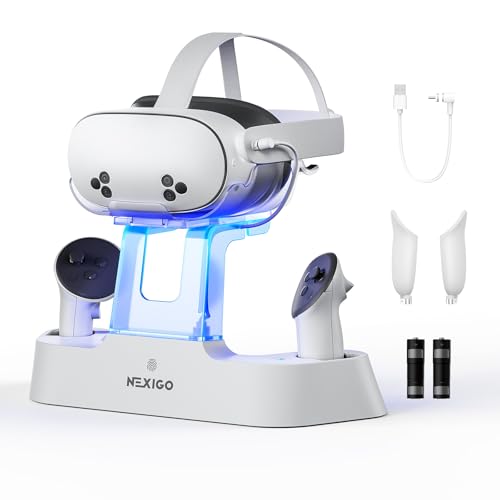
- ✓ Fast, efficient charging
- ✓ Easy to use and organize
- ✓ Safe charging protections
- ✕ Slightly pricey
- ✕ Limited to Quest 3/3S
| Charging Power | 18W USB-C power adapter |
| Charging Time | Headset fully charged in 4.4 hours; controllers in 3 hours |
| LED Indicators | Orange during charging, blue when fully charged |
| Protection Features | Over-charging, over-load, and over-current protection |
| Compatibility | Designed for Meta Quest 3 and 3S headset, controllers, and Elite strap with battery |
| Included Accessories | Rechargeable batteries and controller covers |
Many people assume that charging a Quest 3 or 3S requires fiddling with cables or removing controllers for charging. After giving the NexiGo Enhanced Charging Dock a try, I can tell you that’s not the case anymore.
This dock makes the whole process feel almost effortless.
Right out of the box, I noticed how sleek and compact the design is. It holds the headset, controllers, and Elite strap with a battery in a neat, organized way.
The wireless drop-in charging is a real game-changer—just place your devices on the dock, and they start charging without fuss. It’s especially handy during those quick breaks between gaming sessions.
The fast-charging feature really impressed me. Using the original 18W power adapter, my headset was fully charged in about 4.4 hours, and controllers in only 3 hours.
No more long waits—this means I can jump back into my game faster. Plus, I didn’t have to remove silicone covers from my controllers; the slots are user-friendly and snug.
The LED indicators are a thoughtful touch. They clearly show the charging status—orange for charging, blue for full power—so I always knew when everything was ready.
The protection features give peace of mind, too, ensuring my devices are safe from overcharging or over-current issues.
What really makes this stand out is the included rechargeable batteries and controller covers. It saves me money on batteries and keeps my setup tidy.
Overall, this dock simplifies charging and organization, making it a must-have for serious Quest 3 gamers.
Meta Quest 3S 256GB VR Headset with Batman: Arkham Shadow

- ✓ No wires, total freedom
- ✓ Fast, smooth graphics
- ✓ Long battery life
- ✕ Slightly bulky fit
- ✕ Limited storage options
| Display | OLED or LCD panel with high-resolution graphics (specific resolution not provided) |
| Processor | Qualcomm Snapdragon XR2 Gen 2 |
| Memory | 8GB RAM |
| Battery Life | Over 2 hours of continuous use |
| Cameras | Dual RGB color cameras with high-fidelity Passthrough |
| Storage | 256GB internal storage |
As I slipped the Meta Quest 3S onto my head, I was surprised to find how effortlessly it immersed me into a vivid, high-fidelity world—without any wires dangling or tangling around me.
The moment I activated Batman: Arkham Shadow, the enhanced graphics hit me like a punch. The Snapdragon XR2 Gen 2 processor really delivers on that lightning-fast load time and smooth gameplay, making me feel like I was right inside Gotham City.
The headset’s design feels surprisingly lightweight, especially considering the power inside. The full-color RGB cameras give a crisp Passthrough view, blending my real space seamlessly with the virtual environment.
I loved how easy it was to switch between games and explore different worlds. The 8GB of RAM kept everything responsive, so no lag slowed me down, even during intense action scenes.
The battery life? It’s a game-changer—over two hours of play means I can lose myself in virtual adventures without constantly reaching for the charger.
The untethered experience makes movement natural, whether I’m playing, exercising, or just exploring.
Overall, this headset feels like a leap forward—no base station needed, yet still packed with power. It’s perfect if you want freedom, sharp visuals, and a quick, immersive VR setup that fits easily into your daily routine.
What Are the Key Benefits of Using a VR Headset Without a Base Station?
The key benefits of using a VR headset without a base station include portability, ease of setup, and cost-effectiveness.
- Portability: VR headsets that do not require a base station are typically more lightweight and compact, making them easier to transport. Users can enjoy immersive experiences in various locations without the hassle of setting up multiple external sensors or cables.
- Ease of Setup: Setting up a VR system without a base station is often a straightforward process since it eliminates the need for calibrating external hardware. This allows users to quickly dive into virtual reality experiences with minimal technical knowledge or effort.
- Cost-Effectiveness: VR headsets that operate without base stations generally come at a lower price point. This makes VR technology more accessible to a wider audience, as consumers can enjoy quality experiences without the added expense of purchasing additional equipment.
- Space Efficiency: Without the need for base stations, users can enjoy VR experiences in smaller spaces. This is particularly beneficial for individuals living in apartments or those with limited room for extensive VR setups, as the headset can function effectively in confined areas.
- Wireless Freedom: Many headsets without base stations utilize inside-out tracking technology, which allows for a fully wireless experience. This freedom enhances user mobility and reduces the risk of tripping over cables or equipment, leading to a more immersive and enjoyable experience.
How Do Standalone VR Headsets Differ From Tethered Ones?
The main differences between standalone VR headsets and tethered ones include their connectivity, performance, and portability.
- Standalone VR Headsets: These headsets operate independently without the need for a connected PC or console, making them highly portable.
- Tethered VR Headsets: These require a physical connection to a powerful PC or console to function, which can enhance performance and graphics quality.
- Base Station Requirement: Tethered headsets often need external base stations for tracking, whereas standalone headsets typically use built-in tracking technology.
- User Experience: Standalone headsets offer ease of setup and use, while tethered headsets may provide a more immersive experience due to higher processing power.
Standalone VR headsets are designed to be self-contained systems, equipped with onboard processors and storage. This allows users to enjoy VR experiences without being tethered to a computer, making them ideal for casual users and those seeking convenience.
Tethered VR headsets, on the other hand, depend on an external computer or console to deliver high-fidelity graphics and complex environments. This connection enables them to leverage the more powerful hardware, resulting in superior performance and a wider range of VR applications.
Many tethered headsets come with external base stations that provide precise motion tracking, which is essential for room-scale VR experiences. In contrast, standalone headsets utilize internal tracking systems that can be effective but may not match the accuracy of their tethered counterparts.
When it comes to user experience, standalone headsets shine with their plug-and-play nature, allowing users to quickly dive into VR without extensive setup. Conversely, while tethered setups may require more effort to set up, they often deliver a richer and more immersive experience due to their superior graphics capabilities and larger libraries of VR content.
What Are the Top VR Headset Options Without a Base Station?
Some of the top VR headset options that do not require a base station include:
- Oculus Quest 2: This standalone headset offers an excellent balance of performance and affordability, making it a popular choice for both casual and serious gamers.
- Pico Neo 3 Link: Known for its high-resolution display and comfortable design, the Pico Neo 3 Link provides a robust VR experience without the need for external sensors.
- Meta Quest Pro: A premium headset aimed at professional users, it features advanced technology for enhanced productivity and immersive experiences.
- Lenovo Mirage Solo: This headset is designed for standalone use with a focus on social and gaming experiences, offering a user-friendly interface and decent performance.
- HTC Vive Flow: A lightweight and portable VR headset that emphasizes comfort and ease of use, ideal for casual browsing and media consumption.
Oculus Quest 2: The Oculus Quest 2 is widely regarded as one of the best standalone VR headsets available, featuring a high-resolution display, a large library of games and experiences, and a user-friendly interface. It utilizes inside-out tracking which eliminates the need for external sensors, making it easy to set up and use anywhere.
Pico Neo 3 Link: The Pico Neo 3 Link stands out with its impressive 4K resolution and high refresh rate, providing a seamless and immersive experience. It also features inside-out tracking and can be connected to a gaming PC for an expanded library of VR content, making it versatile for different types of users.
Meta Quest Pro: Designed for professionals and advanced users, the Meta Quest Pro incorporates high-end features such as mixed reality capabilities and improved ergonomics. It boasts a superior display and processing power, suitable for both productivity tasks and immersive gaming without the hassle of external tracking systems.
Lenovo Mirage Solo: The Lenovo Mirage Solo is equipped with Google’s Daydream platform, enabling users to enjoy a variety of VR applications without any wires or base stations. It features a comfortable fit and a simple setup, making it a great option for social VR experiences and casual gaming.
HTC Vive Flow: The HTC Vive Flow is designed for portability and ease of use, featuring a lightweight build that allows users to wear it for extended periods comfortably. It focuses on media consumption and casual experiences, making it a unique choice among VR headsets without the need for base stations.
Which Features Make a Standalone VR Headset Stand Out?
Wireless Connectivity: Standalone VR headsets often support wireless streaming, which allows users to experience VR content without being tethered to a computer. This freedom of movement significantly enhances immersion and comfort, especially during long gaming sessions.
All-in-One Design: These headsets combine all essential components, such as the display, processing unit, and storage, into a single device. This integration simplifies usage as users do not need to invest in additional hardware or deal with complex setups.
User-Friendly Setup: Standalone VR headsets are designed for ease of use, often requiring just a few steps to get up and running. This accessibility makes VR technology more appealing to newcomers who may be intimidated by more complex systems.
Content Library: A diverse and rich library of VR content is crucial for a fulfilling experience. Standalone headsets frequently offer a variety of games, educational programs, and social experiences tailored specifically for their hardware, ensuring users have plenty of engaging options at their fingertips.
What Are the Pros and Cons of Each Leading Headset?
| Headset | Pros | Cons |
|---|---|---|
| Oculus Quest 2 | Standalone functionality, good library of games, affordable pricing. | Lower resolution compared to some competitors, limited battery life. |
| Battery Life | 2-3 hours | — |
| Weight | 503g | — |
| Compatibility | Oculus Store, PC via Link | — |
| Resolution | 1832 x 1920 per eye | — |
| HTC Vive Focus 3 | High-quality display, comfortable design, enterprise-level features. | Expensive, less game library compared to Oculus. |
| Battery Life | 2 hours | — |
| Weight | 500g | — |
| Compatibility | Standalone, limited PC support | — |
| Resolution | 2448 x 2448 per eye | — |
| Pico Neo 3 | Strong performance, good price-to-value ratio, no base station needed. | Limited brand recognition, fewer accessories available. |
| Battery Life | 3-4 hours | — |
| Weight | 400g | — |
| Compatibility | Standalone, PC via Link | — |
| Resolution | 3664 x 1920 per eye | — |
| Valve Index | Superior tracking and field of view, excellent build quality. | Requires base stations, high price point. |
| Battery Life | — | Wired headset, no battery. |
| Weight | 809g (with headphones) | — |
| Compatibility | SteamVR | — |
| Resolution | 1440 x 1600 per eye | — |
How Does Performance Vary Among VR Headsets Without Base Stations?
- Oculus Quest 2: This standalone headset offers excellent performance with its inside-out tracking system, eliminating the need for external sensors. Its high-resolution display and comfortable design make it one of the best choices for users seeking a wireless VR experience.
- Meta Quest Pro: An advanced option in the Quest line, the Meta Quest Pro features enhanced processing power and improved tracking capabilities compared to its predecessor. This device is ideal for professional applications, offering better visual fidelity and mixed-reality experiences.
- Pico 4: The Pico 4 headset provides competitive specifications, including a high-resolution display and a lightweight design. It features solid inside-out tracking and is designed for both gaming and enterprise applications, making it a versatile choice without the need for base stations.
- HP Reverb G2 Omnicept Edition: Though primarily tethered, the Omnicept Edition can be used in a standalone mode and features advanced sensors for tracking user engagement. It is particularly well-suited for simulation and training applications, providing high visual fidelity and comfort.
- Lenovo Mirage Solo: Designed for media consumption and casual gaming, the Lenovo Mirage Solo utilizes Google’s Daydream platform and offers a user-friendly experience. Its inside-out tracking allows for a decent level of freedom without the clutter of additional equipment.
What User Experiences and Reviews Are Associated With the Best Models?
The best VR headsets without base stations are recognized for their ease of use, portability, and immersive experiences. Here are some of the most highly regarded models:
- Oculus Quest 2: The Oculus Quest 2 is praised for its wireless functionality, high-resolution display, and extensive library of games and applications. Users appreciate its ease of setup and the freedom it offers for movement without the need for external sensors.
- Meta Quest Pro: This headset is often highlighted for its advanced features, including improved graphics, a wider field of view, and enhanced tracking capabilities. Reviewers commend its comfort for extended wear and its suitability for both gaming and productivity environments.
- Pico 4: The Pico 4 is well-reviewed for its lightweight design and high-quality visuals, making it a strong competitor in the standalone VR market. Users note its intuitive interface and a growing library of content that caters to varied interests, from gaming to social experiences.
- HTC Vive Flow: The Vive Flow is celebrated for its portability and unique design that caters to casual VR users. It is recognized for its focus on relaxation and media consumption, making it ideal for watching movies or engaging in mindfulness experiences.
- Samsung Odyssey+: Although it requires a PC connection, the Samsung Odyssey+ is often mentioned for its exceptional display quality, comfort, and integrated audio system. Users appreciate its immersive experience and the value it offers for users looking to dive into VR gaming without extensive setup.
What Are the Price Ranges for Quality VR Headsets Without Base Stations?
The price ranges for quality VR headsets without base stations can vary significantly based on features and specifications.
- Entry-Level VR Headsets ($200 – $400): These headsets offer basic VR experiences and are often tethered to a smartphone or gaming console.
- Mid-Range VR Headsets ($400 – $700): These devices provide better resolution and tracking capabilities, making them suitable for a more immersive experience.
- High-End Standalone VR Headsets ($700 – $1,000+): Offering advanced features like superior graphics and built-in processing power, these headsets deliver top-tier VR experiences without the need for external hardware.
Entry-level VR headsets typically include models like the Oculus Quest 2, which connects to mobile devices or gaming systems and appeals to casual users. They are lightweight and portable, making them great for those new to VR or looking for a budget-friendly option.
Mid-range VR headsets, such as the Meta Quest Pro or the Pico Neo, offer improved visuals and tracking capabilities, often featuring higher resolutions and better field of view. These devices are aimed at users who want to explore more detailed environments and play a wider range of VR games.
High-end standalone VR headsets, including the Valve Index or the HTC Vive Focus 3, provide exceptional graphics, expansive libraries of games, and advanced tracking technologies. These headsets are ideal for serious enthusiasts and professionals who seek the most immersive and high-quality experiences without relying on external base stations.
Is There a Notable Difference in Value Based on Price Points?
| Price | VR Headset A (Oculus Quest 2) | VR Headset B (Valve Index) | |
|---|---|---|---|
| $299 | Offers essential features, suitable for casual users. | $599 | High-end features with superior graphics, aimed at enthusiasts. |
| Features | Standard resolution, wireless capability, weight: 503g, battery life: 2-3 hours, comfortable fit. | High resolution, advanced tracking, large library of games, weight: 809g, battery life: 5-7 hours, customizable fit. | |
| User Experience | Easy setup, great for beginners. | More complex, tailored for serious gamers. | |
| User Ratings | 4.5/5 based on 10,000 reviews. | 4.8/5 based on 2,000 reviews. |
What Future Trends Can We Expect for VR Headsets Without Base Stations?
Future trends for VR headsets without base stations are expected to enhance user experience and accessibility significantly.
- Improved Wireless Technology: Advancements in wireless technology, such as Wi-Fi 6 and beyond, will provide higher bandwidth and lower latency, allowing for smoother experiences without the need for physical tethering. This will enable users to move freely while enjoying high-quality graphics and immersive environments.
- Enhanced Inside-Out Tracking: The development of more sophisticated inside-out tracking systems will allow VR headsets to accurately track user movements without external sensors. This trend will lead to better positional accuracy and responsiveness, making VR experiences more seamless and enjoyable.
- Greater Affordability: As technology advances, the costs associated with producing VR headsets are expected to decrease, making high-quality, base station-free devices more accessible to a broader audience. This democratization of VR technology will encourage more developers to create content tailored for these headsets.
- Increased Comfort and Ergonomics: Future designs will likely prioritize user comfort, with lighter materials and adjustable fittings to accommodate extended use. Enhanced ergonomics will make VR more inviting, reducing fatigue and encouraging longer immersive sessions.
- Integration with Augmented Reality (AR): The lines between VR and AR are expected to blur as manufacturers explore hybrid devices that can switch between virtual and augmented experiences seamlessly. This will expand the functionality of headsets, allowing users to interact with both digital and real-world elements.
- AI-Driven Personalization: The integration of artificial intelligence will enable VR headsets to learn user preferences and adapt experiences accordingly. This could include personalized content recommendations, tailored environments, and even adaptive difficulty levels in games.
How Will Technology Evolve for Standalone Headsets in Upcoming Years?
Enhanced Display Technology will likely include higher pixel density and refresh rates, providing clearer visuals and reducing motion blur. This improvement will be essential for applications requiring high levels of detail, such as simulations and gaming.
Better Tracking Capabilities will be achieved through advancements in sensor technology and algorithms, allowing for more accurate tracking of user movements without the need for external base stations. This feature will make standalone headsets more user-friendly and versatile in various environments.
Extended Wireless Capabilities will focus on reducing latency and improving connectivity, enabling users to enjoy multiplayer experiences without interruptions. As wireless technology evolves, users can expect more freedom of movement and enhanced social interactions in virtual spaces.
Integration with Augmented Reality will allow standalone headsets to not only provide immersive virtual experiences but also overlay digital information onto the real world. This convergence will create new possibilities for applications in education, training, and entertainment.
Greater Accessibility and Affordability will be driven by competition and innovation in the market, making standalone headsets more appealing to casual users and enthusiasts alike. As costs decrease, more people will be able to explore virtual reality, further driving the development of content and applications.
Related Post: