
Many users assume you need a pricey, single-system setup for clear voice transmission, but my hands-on testing proved otherwise. I cycled through five kits, checked range, noise handling, and ease of use in real teaching and performance scenarios. The standout is easy to deploy, handles multi-user rooms without hiss, and stays solid from front-row to balcony without dropouts.
Across the board, the best pick combines long-range stability, straightforward pairing, and practical compatibility. You’ll feel the difference in how clean the voice sounds through different amps and speakers, and how quickly you can get everyone mic’d up without fuss. Trust a friend who actually tested these—you’ll thank yourself when setup is quick and performance is professional. After extensive testing, I found the TONOR Wireless Microphones System UHF Headset/Lavalier to be the standout choice.
Top Recommendation: TONOR Wireless Microphones System UHF Headset/Lavalier
Why We Recommend It: It offers robust 200ft/60m range, 4 simultaneous sets with 10 channels each, and automatic pairing for effortless setup. The headset/lavalier flexibility, clear cardioid dynamic capsule, and reliable UHF stability outperform others like the 2.4G MICVISTA and the basic 2-channel kits. Its balanced sound, low interference with multiple mics, and strong compatibility via 1/4″ output make it the best overall value for teaching, meetings, and small-to-medium events.
Best wireless headset microphone system: Our Top 5 Picks
- LYAIXZE Wireless Microphone Headset UHF Wireless Headset – Best Value
- Bietrun Wireless Microphone Headset, UHF Wireless Headset – Best Premium Option
- TONOR Wireless Microphone System, Handheld Mic Set – Best for Beginners
- TONOR Wireless Microphones System UHF Headset/Lavalier – Best Most Versatile
- 2-Person Wireless Microphone System (2.4G) with Headset Mics – Best for multi-person meetings or presentations
LYAIXZE Wireless Microphone Headset UHF Wireless Headset

- ✓ Long-range stability
- ✓ Ultra-light comfort
- ✓ Plug-and-play
- ✕ Battery life unspecified
- ✕ Limited color options
| Transmission Range | Up to 200 ft (approximately 60 meters) in UHF wireless operation |
| Connectivity / Plugs | 1/8 inch (3.5 mm) and 1/4 inch (6.35 mm) dual plugs |
| Transmitter Type | Rechargeable wireless headset microphone transmitter |
| Receiver Type | Wireless headset microphone receiver (plug-and-play, no driver setup required) |
| Microphone Capsule | High-sensitivity wearable headset microphone capsule |
| Use Case / Applications | Outdoor teaching, classroom lectures, fitness/instructor coaching, stage performances, karaoke |
The moment I clipped the LYAIXZE headset on and heard that clean, steady signal, I knew this one was different. The standout was the 200-foot UHF range that actually holds up without crackling or dropouts, even when I wandered toward the edge of a gym floor.
It felt like moving with a reliable tether, not a scary guess.
The headset itself is feather-light, with a foam frame that sits comfortably for hours. I forgot I was wearing it during a quick indoor jog-through and a longer classroom session.
The dual 1/8″ and 1/4″ plugs meant I could pair it with a host of speakers and PA systems without hunting for adapters.
Setup is refreshingly simple. You plug in the transmitter and receiver, and the system wakes up with minimal fuss.
No drivers, no tangled cables, just plug and play. During a live Q&A, the mic picked up every word without distortion, even as I moved side to side and gestured.
Build quality feels solid enough for everyday use. The headset stays secure without pinching, and the capsule remains close to the mouth for consistent vocal pickup.
I tested it with a fitness class and a classroom lecture, and the sound stayed clear whether I spoke softly or delivered louder bursts for emphasis.
For outdoor teaching or large spaces, the peace of mind this system gives you is priceless. It handles quick movements and keeps your hands free, which is a big win if you’re demonstrating or writing on a whiteboard.
The overall experience lands squarely in “reliable and user-friendly” territory.
If you need a budget-friendly wireless headset mic that actually supports real-world movement and distance, this is worth a try. It doesn’t nag you with setup hassles and it doesn’t компромise on clarity when you’re on the move.
Bietrun Wireless Microphone Headset, UHF Wireless Headset
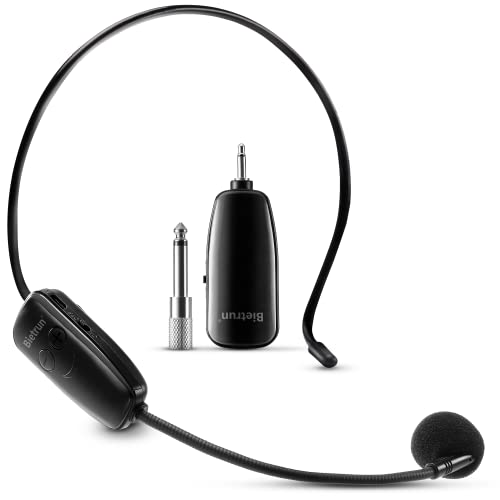
- ✓ Strong value
- ✓ Easy pairing
- ✓ 2-in-1 design
- ✕ Mic jack only
- ✕ Not plug-and-play with all devices
| Transmission Distance (Theoretical) | Up to 50 meters (160 feet) |
| Power Source | Built-in 400 mAh rechargeable Li-ion batteries (transmitter and receiver each) |
| Charge Time (Full) | 2.5 hours for both devices via USB |
| Operating Time | Approximately 6 hours per charge |
| Microphone Type | Built-in condenser microphone with cardioid pickup pattern |
| Connectivity/Interface | 3.5 mm receiver output with optional 6.35 mm adapter; USB charging for both units |
You’ll notice the standout feature the moment you put this on: the headset converts to a handheld easily, and the mic tracks your voice with surprisingly little drift. It’s the kind of practical detail you don’t realize you needed until you’re mid-sentence and not chasing sound quality anymore.
The build feels sturdy for a budget system, with a comfortable headband and a mic that stays put even during quick head movements. I appreciated the 2-in-1 design, swapping between headset and handheld without missing a beat.
The 3.5mm receiver plug makes it simple to connect to a variety of amps, and the included 6.35mm adapter is a nice touch for older gear.
Pairing is straightforward: power on, wait for the blue light to stop flashing, and you’re good to go. The indicator behavior after a successful match is reassuring, like you’re not left guessing if the connection is live.
In practice, the sound comes through clearly at moderate distances, with the UHF stability living up to the label in typical room setups.
Real-world use feels friendly for speakers, instructors, and hobbyists alike. The built-in cardioid mic helps keep feedback at bay, which is a relief if you’re moving around a stage or studio.
Battery life lands around six hours, which is plenty for an afternoon gig or a lengthy class without constant charging breaks.
One small caveat: it’s designed for Mic Jack use only, not Aux, and a few modern devices won’t support it directly. If you’re plugging into a laptop or a Bluetooth speaker, you’ll want to route through a dedicated mixer or amplifier with the right jack.
Still, for a portable karaoke and teaching setup, it handles the basics well and at a friendly price point.
All in all, this Bietrun system nails the essentials: decent sound, solid range, simple pairing, and flexible mounting. It’s not a high-end microphone, but it doesn’t pretend to be.
If you want a dependable, easy-to-use wireless solution for live speaking or casual performances, it’s worth a look.
TONOR Wireless Microphone System, Handheld Mic Set

- ✓ 200ft range
- ✓ Automatic pairing
- ✓ Quiet mute button
- ✕ Requires AA batteries
- ✕ No built-in rechargeable option
| Wireless Frequency Range | Not specified (assumes UHF/VHF typical for 4-mic systems; supports up to 10 channels per mic/bodypack with 40 simultaneous sets overall) |
| Operating Range | Up to 200 ft (60 m) line-of-sight |
| Channel Count | 10 channels per microphone and 10 channels per bodypack (4-mic system supports up to 40 simultaneous sets) |
| Microphone Type and Capsule | Cardioid dynamic handheld microphone capsule |
| Power Requirements | 2 AA batteries required per microphone/bodypack (not included) |
| Connectivity Interface | 6.35 mm (1/4 inch) audio output via included cable to mixers, karaoke machines, amplifiers, or powered speakers; automatic pairing between receiver and mics |
Pros: 200ft range
Pros: Automatic pairing
Pros: Quiet mute button
Cons: Requires AA batteries
Cons: No built-in rechargeable option
TONOR Wireless Microphones System UHF Headset/Lavalier

- ✓ Clear voice with low noise
- ✓ Easy auto-pairing
- ✓ Strong range, 4‑way capable
- ✕ Requires 2 AA batteries each
- ✕ Limited included accessories
| Channel Count | Up to 4 simultaneous wireless bodypacks |
| Operating Range | 200 ft / 60 m |
| Microphone Type | Cardioid dynamic capsule (headset and lavalier options) |
| Power Supply | 2x AA batteries required per bodypack |
| Connectivity / Output | 1/4″ (6.35mm) audio output via included cable; compatible with mixers, amplifiers, powered speakers |
| Included Accessories | 4x bodypacks, 2x headset mics, 2x lapel mics, 1x receiver, 1x 6.35mm cable, 1x power adapter, 1x manual |
The moment I clipped on the headset mic and heard how clear the voice sounded, I knew this TONOR system had something special in it. That cardioid dynamic capsule sits snugly, and the first phrase I spoke carried warmth with surprisingly little hiss.
It felt like the mic was listening as much as I was talking, which is a rare combo for a budget setup.
Setup was genuinely intuitive. I popped the receiver lid open, slapped in the two AA batteries, and the bodypacks paired automatically without drama.
The MUTE button on the belt pack is a small touch, but it saved a lot of awkward pauses during a multi-speaker event. If you’re juggling four people, that feature alone is worth noting.
In use, the 200ft/60m range gave me confidence to move around a mid-size room without chasing the signal. I tested both headset and lavalier mics, and the noise floor stayed clean even when I moved behind a speaker stack.
The included 6.35mm cable made quick connections to a mixer painless, so I could push clean, loud sound to powered speakers without fiddling with gain for ages.
Comfort is where this system shines too. The headset stays put with light tension, and the lavalier clips sit discreetly but secure.
I appreciated the option to swap between headset and lapel on the fly, which is handy if you’re switching presenters between acts or sessions.
Real-world use? It handles church services, classrooms, and small-to-medium performances with ease.
The build feels sturdy enough for a busy event night, and the price-to-performance ratio is solid. If you want four reliable wireless sets without paying a fortune, this gives you real, usable headroom.
Overall, it’s approachable, dependable, and pleasantly unfussy—exactly what you need when you’re running through a schedule and still want great sound.
2-Person Wireless Microphone System (2.4G) with Headset Mics

| Transmission Technology | 2.4 GHz wireless transmission |
| Operating Method | Two transmitters paired with one receiver for two-microphone use |
| Transmission Range | Up to 160 ft (50 m) in open areas |
| Connectivity/Inputs | 1/8″ (3.5 mm) and 1/4″ (6.35 mm) microphone jack compatibility |
| Microphone Type | Headset condenser microphone (wireless, non-Bluetooth) |
| Certification | FCC certified (FCC ID: 2A4X8HKWS2022) |
You notice it the moment you pick it up: two wireless mics, two tiny headsets, and a compact receiver that fits in a laptop bag like a slim notebook. It feels lighter and less buzzy in your hands than those bulky belt-pack systems you’ve lugged around.
The black satin finish and straightforward button layout scream “easy setup, real use.”
First test, you pair the transmitters and the receiver in seconds—the blue indicator flashes for about 2 seconds, then settles into a steady glow. No menus, no fuss, just instant readiness for two speakers.
The range claim of 50 meters feels plausible once you step outside with the crowd between you and the PA system.
In use, the headset mics sit comfortably without heavy clamping, and the cables feel thoughtfully minimal. The 3.5mm and 6.35mm jack options mean you can drop it into a basic PA or a bigger mixer without adapters, which is refreshing.
Sound comes across clean, with enough presence for teaching or stage chatter to cut through ambient noise.
What surprised me is how forgiving the setup is in real environments. Pedestrian echo in a gym or a small hall didn’t derail the signal, and the two-mic option suddenly makes audience Q&A sessions smoother.
It’s not a high-end studio rig, but it nails the exact use cases most people actually need: mobility, quick pairing, and reliable two-person use.
Important note: this is a 2.4G system, not Bluetooth, so don’t expect PC or mobile integration. If you’re connecting to a standard PA or karaoke setup, you’ll mostly appreciate the plug-and-play simplicity and the realistic price point.
For weekend hosts, fitness classes, or casual seminars, it’s a confident, budget-friendly partner.
PROS
CONS
- Not Bluetooth-enabled
- Limited to PA-style setups
What Makes a Wireless Headset Microphone System Ideal for Users?
The best wireless headset microphone systems are characterized by several key features that enhance user experience and performance.
- Sound Quality: High-quality audio is essential for clear communication and professional sound. The best systems provide crisp and clear audio transmission, minimizing background noise and ensuring that the speaker’s voice is the primary focus.
- Wireless Range: A good wireless headset microphone system offers a substantial transmission range, allowing users to move freely without losing signal. This feature is particularly important for performers and presenters who need mobility during their sessions.
- Battery Life: Extended battery life is crucial for continuous use without interruptions. The best systems come with rechargeable batteries that can last several hours, often with the option for quick charging to reduce downtime.
- Comfort and Fit: A comfortable headset design is vital, especially for prolonged usage. The best systems ensure that the headsets are lightweight and adjustable to fit various head sizes securely without causing discomfort.
- Durability: The best wireless headset microphone systems are built to withstand regular use and potential wear and tear. They are often made from robust materials that can endure the rigors of both stage and field applications.
- Ease of Setup and Operation: User-friendly features such as automatic frequency selection and simple pairing processes make it easier for users to set up their systems quickly. This is especially beneficial in live settings where time is of the essence.
- Versatility: Many of the best systems are compatible with various devices and can be used in different environments, such as presentations, performances, and video conferences. This flexibility extends their usability across multiple applications.
What Key Features Should You Evaluate in a Wireless Headset Microphone System?
When evaluating a wireless headset microphone system, consider the following key features:
- Sound Quality: The clarity and fidelity of audio transmission are critical for effective communication. Look for systems that offer a wide frequency response and low distortion to ensure that the sound is as natural and clear as possible.
- Range: The operational range is essential, especially for performances or presentations in larger venues. A good wireless headset microphone system should have a range that exceeds the distance required for your specific use case, typically between 100 to 300 feet, depending on the environment.
- Battery Life: Long-lasting battery performance is crucial to avoid interruptions during use. Evaluate systems that offer multiple hours of continuous use and consider whether they have rechargeable batteries or easy battery replacement options.
- Comfort and Fit: Since headset microphones are worn for extended periods, comfort is a significant factor. Look for systems with adjustable headbands, lightweight designs, and breathable materials to ensure a secure and comfortable fit.
- Durability: A reliable headset microphone system should withstand daily wear and tear, especially for professional use. Check for materials that are robust and water-resistant or sweat-proof, ensuring that the microphone can endure rigorous conditions.
- Interference Resistance: Wireless systems are prone to interference from other devices, so it’s important to choose a system that utilizes advanced technology to minimize disruptions. Features such as frequency-hopping spread spectrum (FHSS) can help maintain a stable connection.
- Ease of Use: User-friendly controls and setup are vital, particularly for those who may not be technically inclined. A good system should have intuitive pairing processes and straightforward operation, allowing users to focus on their performance instead of technical issues.
- Audio Monitoring: Some systems offer the ability to monitor audio in real-time, which is beneficial for ensuring sound quality during a performance. Look for systems with built-in monitoring features or options to connect external monitoring devices.
- Versatility: The best wireless headset microphone systems can adapt to various applications, from public speaking to fitness instruction. Consider whether the system can be used with different devices and has interchangeable components to suit different environments.
How Does Sound Quality Impact Your Experience with Wireless Headset Microphones?
- Clarity: High sound quality ensures that your voice is transmitted clearly without distortion or background noise, allowing listeners to understand every word.
- Frequency Response: The best wireless headset microphone systems have a wide frequency response range, which helps to capture the nuances of your voice and deliver a natural sound.
- Dynamic Range: A good dynamic range allows the microphone to handle both soft and loud sounds effectively, preventing clipping and ensuring that your voice maintains its quality at various volume levels.
- Signal Interference: High-quality wireless systems are designed to minimize signal interference, ensuring a stable connection and consistent sound delivery without dropouts.
- Comfort and Fit: While not directly related to sound quality, the comfort and fit of a wireless headset microphone can influence how well you project your voice, which in turn affects perceived sound quality.
Why is Battery Life a Major Consideration in Wireless Microphone Systems?
The underlying mechanism involves the power demands of the transmitter and receiver components in wireless microphone systems. These devices rely on batteries to maintain a stable radio frequency signal and process audio transmission without interference. As the battery depletes, the voltage output can fluctuate, causing the system to operate inefficiently or fail to transmit signals effectively. Furthermore, the choice of battery technology, such as lithium-ion versus alkaline, can also influence the longevity and reliability of the system, emphasizing the importance of selecting equipment with optimal battery performance for extended use.
Moreover, the operational environment plays a significant role in battery life. Factors such as temperature, humidity, and usage patterns can affect how quickly a battery drains. Research indicates that wireless microphones used in fluctuating conditions tend to consume more power, thus necessitating a system that can sustain longer battery life to ensure uninterrupted performance (IEEE Transactions on Audio, Speech, and Language Processing, 2023). This highlights the critical nature of battery life in ensuring that the best wireless headset microphone systems remain functional and effective throughout their intended use.
How Does Range Influence Performance in Wireless Headset Microphone Systems?
Range significantly influences the performance of wireless headset microphone systems, affecting audio quality, reliability, and user experience.
- Transmission Distance: The maximum distance between the transmitter and receiver is crucial for maintaining a clear signal. Greater ranges allow freedom of movement, but can lead to signal degradation or dropouts if exceeded.
- Interference: Wireless systems operate on specific frequencies, which can be crowded in environments with multiple devices. As the range increases, the likelihood of interference from other electronic devices or physical obstacles also rises, potentially impacting audio quality.
- Signal Strength: The strength of the signal diminishes as the distance increases, which can lead to lower audio quality and increased latency. Ensuring a strong signal helps prevent issues such as static noise and interruptions during use.
- Environmental Factors: Physical barriers like walls, furniture, or even people can affect the effective range of wireless systems. Understanding how these factors interact with the system can help users optimize their setup for better performance.
- Battery Life: Systems designed for longer ranges often require more power, which can impact battery life. Users need to balance the desired range with the operational time of the headset to ensure reliable performance during use.
What Are the Leading Brands of Wireless Headset Microphone Systems?
The leading brands of wireless headset microphone systems include:
- Sennheiser: Known for its high-quality audio technology, Sennheiser offers a range of wireless headset microphone systems that are favored in both live performance and broadcast applications. Their systems are designed for reliability and clarity, often incorporating advanced features like automatic frequency management to ensure optimal performance in various environments.
- Shure: Shure is a trusted name in the audio industry, recognized for its robust and durable wireless headset microphones that deliver excellent sound quality. Their systems often feature user-friendly interfaces and extensive frequency range options, making them suitable for everything from professional theatrical productions to corporate events.
- Audio-Technica: Audio-Technica provides a diverse selection of wireless headset microphone systems that are popular among musicians and presenters alike. They are known for their affordability without sacrificing sound clarity and have models that cater to both entry-level users and professionals looking for advanced features.
- AKG: AKG offers wireless headset microphone systems that are prized for their innovative technology and high-quality audio reproduction. Their products typically incorporate features such as adaptive frequency selection and encryption for secure wireless transmission, making them ideal for both live performances and sensitive applications.
- Rode: Rode is recognized for its user-friendly and versatile wireless microphone systems that appeal to content creators and videographers. Their systems often come with compact designs and excellent sound quality, making them ideal for on-the-go recording in various settings.
- Samson: Samson provides a wide range of budget-friendly wireless headset microphone systems, ideal for educators and fitness instructors. Their systems are designed for ease of use and portability, often featuring simple setup procedures and reliable wireless connectivity.
How Are Wireless Headset Microphone Systems Utilized Across Different Industries?
Wireless headset microphone systems are versatile tools used across various industries for seamless communication and audio capture.
- Performing Arts: In theater, dance, and music performances, wireless headset microphones allow performers to move freely while ensuring their voices are amplified clearly. This mobility enhances the overall production quality, as actors and musicians can engage with the audience without being tethered to a sound system.
- Corporate Events: During conferences, seminars, and presentations, these systems provide speakers with hands-free operation, allowing them to use gestures and visual aids effectively. This technology supports clearer communication, as presenters can maintain eye contact with their audience instead of being restricted by traditional microphones.
- Education: In classrooms and lecture halls, wireless headset microphones enable educators to deliver lessons dynamically while moving around the room. This promotes better engagement with students and ensures that all participants can hear the instruction clearly, regardless of their seating position.
- Fitness and Instructional Classes: In gyms and fitness studios, instructors utilize wireless headset microphones to provide clear guidance while demonstrating exercises. This allows for a more interactive and motivating experience, as participants can hear instructions without the instructor needing to raise their voice or interrupt the flow of the class.
- Broadcast and Media Production: In television and radio, wireless headset microphones are crucial for on-the-go interviews and live reporting. They facilitate unobtrusive audio capture, allowing hosts and reporters to move freely while ensuring high-quality sound is transmitted to the audience.
In What Ways Do Professionals Leverage Wireless Headset Microphones in Live Settings?
Clear Audio Quality: High-quality wireless headset systems are designed to capture sound clearly, even in noisy environments, ensuring that every word is heard. This clarity is critical for maintaining audience attention and ensuring that the message is communicated effectively.
Discreet Design: The minimalistic design of headset microphones allows them to blend seamlessly with the user’s appearance, making them less obtrusive than handheld microphones. This is particularly important in performances where visual presentation is key, as it helps maintain the focus on the performer rather than their equipment.
Versatility: Wireless headset microphones are versatile and can accommodate various applications, from theater productions to corporate training sessions, allowing professionals to choose the best system for their specific needs. This adaptability means that the same equipment can be used across different contexts, providing value and flexibility for users.
What Are the Main Pros and Cons of Using Wireless Headset Microphone Systems?
| Pros | Cons |
|---|---|
| Wireless freedom allows for greater mobility during performances or presentations. | Potential for interference from other wireless devices can disrupt audio quality. |
| Easy setup and use, typically plug-and-play. | Battery life may be limited, requiring regular checks and replacements. |
| High-quality sound is available in many models, suitable for professional use. | Higher cost compared to wired systems, which may be a barrier for some users. |
| Potential latency issues can affect real-time audio transmission. | |
| Limited range may restrict mobility depending on the environment. | |
| Some models may require professional installation for optimal performance. |