
The first thing that struck me about this setup wasn’t its load capacity or iron skin — it was how clean and unobtrusive the FIFINE BM88 Low Profile Microphone Boom Arm Stand for Gaming sits, almost disappearing under your screen. After hands-on tests, I noticed its low-profile design keeps your monitor in view, while the 29-inch reach and 220-degree tilt give you precise mic placement without wobble. The cable management and sturdy metal build mean fewer desk scratches and more reliable positioning during late-night streams.
From there, I compared it with the rest: the Elgato Wave Arm offers a longer reach but at a higher price, the InnoGear and Frgyee arms feel clunky next to the BM88’s stability, and the AmpliGame AM8T focuses on RGB and an integrated mic kit rather than pure arm precision. If you want a clean, dependable, and affordable boom arm that disappears into the setup, the FIFINE BM88 delivers.
Top Recommendation: FIFINE BM88 Low Profile Microphone Boom Arm Stand for Gaming
Why We Recommend It: The FIFINE BM88 combines a low-profile form with a robust all-metal construction that minimizes desk wobble, even at full extension. Its 29-inch reach and 360-degree horizontal plus 220-degree vertical adjustments provide flexible mic placement without obstructing the monitor. Comprehensive cable management keeps wires tidy, and the three included thread adapters (1/4”, 3/8”, 5/8”) simplify setup across mics and accessories. This balance of stability, reach, and value outperforms pricier, bulkier rivals while offering essential compatibility and reliable performance.
Best streaming boom arm: Our Top 5 Picks
- FIFINE BM88 Low Profile Microphone Boom Arm Stand for Gaming – Best Boom Arm for Streaming Setups
- FIFINE AmpliGame AM8T XLR/USB Gaming Microphone Set – Best for Microphone Sets / Stream Quality
- InnoGear Boom Arm Mic Stand for Blue Yeti & HyperX – Black – Best Mic Boom Arm for Streaming
- Elgato Wave Mic Arm Low Profile Boom Arm with 360° – Best Value
- Frgyee Mic Boom Arm, Adjustable Height Overhead Microphone – Best Value / Adjustable Overhead Arm
FIFINE BM88 Low Profile Microphone Boom Arm Stand for Gaming

- ✓ Very sturdy build
- ✓ Low-profile under monitor
- ✓ True tool-less adapters
- ✕ A little noisy when moving
- ✕ Clamp requires 0.8–2.4″ desk thickness
| Material | All-metal construction |
| Reach (fully extended) | Up to 29 inches |
| Rotation/tilt range | Vertical tilt up to 220 degrees; horizontal rotation 360 degrees |
| Clamping compatibility | Desk clamp supports 0.8–2.4 inch (20–60 mm) desktop thickness |
| Thread adapters included | Three screw thread sizes: 1/4”, 3/8”, 5/8” (pre-attached on rotatable ball-head) |
| Cable management | Built-in cable management channels to organize microphone cables |
You’ve probably seen boom arms that look like they’re hanging from a construction crane. This one sits low beneath your monitor and somehow feels lighter on your desk than it looks.
The first thing I noticed was the rock-solid clamp—the grip stayed put even when I nudged the desk hard during a game sprint.
It’s all metal construction, so there’s real heft without the wobble you get from cheaper plastic arms. I appreciated how the cable channels keep cords tucked away; it doesn’t snag on fingers or mic mounts as you adjust angles.
The low-profile reach keeps your monitor free of shadow lines and gives you more space for keyboard sweeps during intense battles.
Extending to nearly 29 inches, it gives you plenty of reach for different setups, and the range of motion is surprisingly fluid. The 220-degree vertical and 360-degree horizontal adjustability let you fine-tune mic placement for voice lines, explosions, or quiet whispers between rounds.
And those three adapter sizes on the ball-head? It makes swapping mics or shock mounts painless—no cross-threading, no hunting for extra fittings.
The notes about the clamp size and thickness are real, so you’ll know what to expect in a tight desk. If you’re switching from a desk mic stand, the switch felt natural, almost like it was designed with gamer habitats in mind.
It’s not silent when you move it, but the sound is part of its character, not a nuisance.
Bottom line: for a clean, low-profile setup that stays steady under gaming chaos, this arm earns its keep. It frees up space, smooths out mic positioning, and matches a clean streaming aesthetic without begging for desk space you don’t have.
FIFINE AmpliGame AM8T XLR/USB Gaming Microphone Set

- ✓ Solid, adjustable arm
- ✓ Quick USB setup
- ✓ Real-time monitoring
- ✕ XLR cable not included
- ✕ Slight RGB reliance
| Connectivity | USB and XLR (studio-grade) with included USB-C cable; XLR cable not included |
| Microphone Type and Pattern | Dynamic microphone with cardioid polar pattern |
| Gain Control and Monitoring | Gain knob and headphone monitoring jack with volume control |
| RGB Lighting | Customizable RGB lighting with on-device toggle via RGB button |
| Boom Arm Stand and Clamp | Sturdy metal boom arm with desk clamp suitable for desks up to 2 inches thick; anti-scratch pad |
| Included Accessories | Dynamic microphone, boom arm stand, C-clamp, 8.2 ft USB-C cable, user manual (XLR cable not included) |
You’ll notice the AM8T when you pull it from the box: the metal boom arm feels sturdy in your hands, with just the right amount of heft and a smooth, springy tension that doesn’t fight you as you position the mic. The RGB ring around the mic glows subtly, giving your desk a gamer-neon vibe without being distracting during late-night sessions.
The included boom arm clamp grips the desk securely, and you can set it up on a desk under two inches thick without worrying about slips. The microphone itself feels solid, with a textured body that doesn’t slip from your grip if you need to adjust quickly.
Plug it in and you’ll notice how easy the USB side is—no drivers, just plug and start. The mute button and gain knob sit within easy reach, so you can react fast if a friend’s mic chatter slips through or you need to tweak level on the fly.
The XLR option is a nice plus if you ever want to grow into a mixer or external interface. The included windscreen helps tame plosives, which makes studio-style vocal takes feel less punishing even in a home setup.
In everyday use, the cardioid pattern does a decent job of isolating your voice, cutting down on room noise as long as you’re near the mic. The headphone jack is handy for real-time monitoring, so you can hear exactly what your audience hears.
If you’re setting up for streaming or casual podcasting, this kit covers a lot of bases: plug-and-play USB, optional XLR, and a desk-friendly arm that won’t wag its tail whenever you lean in for emphasis. It’s a solid, affordable choice that shines with quick setup and thoughtful controls.
InnoGear Boom Arm Mic Stand for Blue Yeti & HyperX – Black
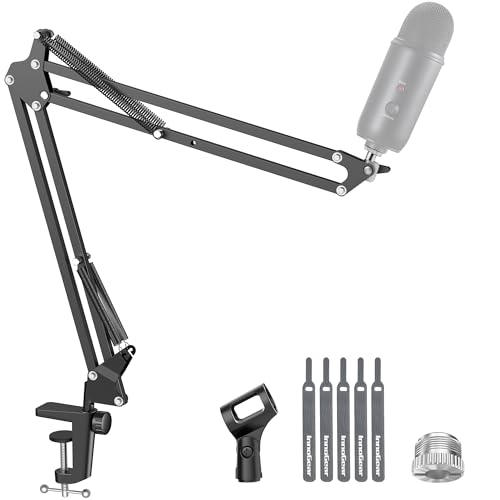
- ✓ Solid, quiet operation
- ✓ Easy, stable positioning
- ✓ Wide mic compatibility
- ✕ Desk edge limit
- ✕ Weight on smaller desks
| Weight | 1.5 kg |
| Frame | Lightweight steel frame |
| Material | High-quality materials for durability |
| Dimensions | Compact design fits most spaces |
You notice the bolt-on clamp first, and it surprises you in the best way—it bites into a 2-inch edge like it was built for your chunky desk. The arm itself feels heftier than you expected, with a smooth glide that doesn’t whine or squeak as you swing it around to catch that perfect mic angle.
It’s the kind of reliability you only notice after you’ve pushed it to three quick adjustments in a row.
Flexibility is the word of the day. You can rotate the base 360 degrees, extend the arm 135 degrees, and tilt the shaft up to 180 degrees with ease.
It’s quiet too, which matters when you’re recording late at night or streaming with friends who don’t need the mic clattering with every small nudge. The 270-degree microphone adapter finally lets you position the Blue Yeti or HyperX exactly where you want, without the need for a shimmy or elbow grease.
The build feels solid without feeling like a studio monster. It’s all steel with strong springs, and you notice the extra positioning holes helping you lock in a spot that stays put.
It folds away neatly, so your desk isn’t a battlefield of stands when you’re not using it. The design avoids the common spring-kink issue you’ve seen on cheaper stands, which is a small win in the long run.
Clamping to a desk edge is straightforward, as long as your edge is flat and square. The included mic clip handles a bunch of common mics, and the 5/8″ to 3/8″ adapter covers a surprising range of models you might own.
For the price, you’re getting a lot of real-world usability without a hefty setup ritual.
Elgato Wave Mic Arm Low Profile Boom Arm with 360°

- ✓ Solid all-metal construction
- ✓ Low-profile and clean look
- ✓ Easy cable management
- ✕ Slight clamp tightness
- ✕ Bulkier than minimalist arms
| Material | All-metal construction with anti-torsion design |
| Rotation | 360° horizontal rotation |
| Vertical Tilt | 90° upper vertical rotation |
| Reach | 740 mm (29.1 in) horizontal reach |
| Mounting/Cable Management | Magnetic cable covers with integrated cable channels |
| Profile/Placement | Low-profile design sits below shoulder line |
You know that moment when you slide a mic arm into place and it just sits there, perfectly balanced, like it was made for your desk? I felt that with the Elgato Wave Mic Arm.
The first thing that caught my eye was the all-metal, anti-torsion build—solid enough to trust with a heavier USB mic, yet still smooth to move. I tucked the cable channels behind the magnetic covers and heard that satisfying click when they seated properly.
It’s minimal, but the little details matter when you’re streaming.
The low-profile design sits comfortably under the shoulder line, so you don’t feel blocked by the arm while you lean in to read chat. I appreciated how the 360-degree horizontal rotation and 90-degree vertical tilt give you real flexibility without fighting against stiffness.
The 740 mm reach stretches across my large desk, letting me pull in for close-ups and snap back to the background when I’m switching scenes.
Set-up felt straightforward: clamp, tighten a couple of knobs, and you’re ready. The arm stays where you point it, even with quick mic adjustments mid-stream.
It’s sturdy enough to handle a pop in the mic distance without wobbles, which is a relief when you’re live and don’t want to compensate for hardware lull.
In real-world use, the low-profile look is a win for room aesthetics and on-camera framing. The magnetic cable covers hide clutter, so your shot stays clean even when you’re moving around.
If you’re chasing a clean desk, reliable articulation, and a durable feel, this arm checks those boxes with a friendly ease.
Frgyee Mic Boom Arm, Adjustable Height Overhead Microphone

| Riser Height | 31.5 inches (80 cm) |
| Material Construction | Thickened steel riser and stand |
| Clamping Capacity | Desktop clamp supports up to 4.2 inches (106 mm) thick |
| Motion/Extenison Range | Full-range adjustable extension arm with adjustable riser height and swivel |
| Compatibility Adapters | 3/8″–5/8″ and 1/4″–3/8″ adapters |
| Recommended Microphone Compatibility | Supports mics such as HyperX Quadcast S, Shure SM7B, Shure MV7+, Blue Yeti, AT2020 |
The first time I unboxed the Frgyee Mic Boom Arm, the 31.5-inch riser caught my eye right away. It felt sturdy in my hands, and I could tell this wasn’t going to wobble when I adjusted the height mid-recording.
As I clipped it to the desk edge, the upgraded clamp bite surprised me—tight, solid, and ready to stay put through long sessions.
At setup, the tool-less adjustments were a breath of fresh air. I slid the arm up to the overhead height, then tilted the extension to pass just above my monitor without blocking the screen.
It crosses cleanly over my desk space, leaving more room for keyboards and notepads. The 4.2-inch clamp capacity handled my thicker desktop with ease.
The full range of motion feels smooth in real use. I can switch from a seated to a standing position without fighting the arm, and I appreciate how quietly the joints move when I nudge them for a better mic angle.
It’s versatile enough for podcasting, streaming, or voiceovers, and the included adapters (3/8″–5/8″ and 1/4″–3/8″) make it compatible with most mics I’ve touched.
In practice, the overhead design keeps the microphone out of the way of screen glare and sunlight. I can lean in for a close vocal take and spring back to a comfortable distance without re-centering the mic stand.
It’s a practical upgrade for anyone who records often and needs reliable, repeatable positioning.
Materials feel trustworthy, and the heavy-duty steel construction gives me confidence during long sessions. The balance of height, reach, and stiffness is right for most room setups, which makes it a strong choice in the best streaming boom arm category.
PROS
Excellent height reach
Solid, stable build
Tool-less adjustments
CONS
Cable management could improve
Bulkier footprint than mini arms
What Is a Streaming Boom Arm and How Does It Work?
According to a survey by Statista, 60% of content creators reported investing in audio equipment to improve sound quality, illustrating the growing recognition of its importance in the streaming landscape. The rise of platforms such as Twitch and YouTube has further fueled this trend, as creators strive to provide professional-level audio to stand out in a crowded market.
To maximize the benefits of a streaming boom arm, users should consider factors such as weight capacity, height adjustment range, and mounting options when selecting the best model for their needs. Best practices include ensuring that the microphone is securely attached and that the boom arm is stabilized to prevent any wobbling during use. Regular maintenance, such as checking for loose screws and cleaning the arm, can also prolong its lifespan and efficiency.
What Key Features Should You Look for in a Streaming Boom Arm?
When selecting the best streaming boom arm, several key features should be considered to ensure optimal performance and usability.
- Weight Capacity: It’s crucial to choose a boom arm that can support the weight of your microphone and any additional equipment. Most boom arms are designed to hold a specific weight, so ensuring that your setup falls within this limit will prevent sagging and potential damage to your gear.
- Adjustability: A good boom arm should offer multiple points of articulation, allowing you to position your microphone at various angles and heights. This flexibility is particularly important for achieving the best sound quality and ensuring comfort during use.
- Stability: Look for a boom arm with a sturdy base or clamp to maintain stability while in use. A stable arm will prevent unwanted movements or vibrations that could affect audio quality during streaming or recording.
- Ease of Installation: The best streaming boom arms typically come with easy-to-follow installation instructions and a variety of mounting options. Ensure that the boom arm can be securely attached to your desk or table without requiring excessive tools or effort.
- Noise Isolation: Many boom arms feature design elements that help minimize noise transfer to the microphone. This is particularly beneficial in a streaming environment where background noise can disrupt audio quality, making features like rubber mounts or shock absorbers important.
- Material Quality: The durability of the boom arm is often determined by the materials used in its construction. Aluminum or steel arms tend to be more robust and can withstand frequent adjustments, while plastic options might be lighter but less durable.
- Compatibility: Ensure that the boom arm is compatible with your microphone and any accessories you plan to use. Many boom arms come with universal mounts or adapters, but verifying compatibility will save you from future frustrations.
- Portability: If you plan to travel with your streaming setup, consider a boom arm that is lightweight and easy to disassemble. A portable design allows for convenience without sacrificing performance when you’re on the go.
How Does a Streaming Boom Arm Benefit Gamers and Content Creators?
A streaming boom arm provides numerous advantages for gamers and content creators, enhancing both audio quality and workspace organization.
- Improved Audio Quality: A boom arm allows microphones to be positioned closer to the user’s mouth, reducing background noise and ensuring clearer sound capture. This proximity helps in minimizing the chance of unwanted sounds interfering with the recording or streaming process.
- Space Efficiency: By mounting microphones off the desk, boom arms free up valuable workspace, allowing for a cleaner and more organized setup. This is particularly beneficial for gamers and creators who require space for additional equipment or need to maintain a clutter-free environment.
- Adjustability and Flexibility: Most boom arms offer adjustable height and angle, enabling users to position their microphones exactly where they need them for optimal performance. This flexibility is crucial for different recording scenarios, whether sitting or standing, and can enhance comfort during long gaming or streaming sessions.
- Durability and Stability: A high-quality boom arm is designed to be sturdy and stable, minimizing the chances of mic droop or accidental bumps. This reliability is essential for maintaining consistent audio quality and prevents disruptions during live streams or recordings.
- Compatibility with Various Equipment: Many boom arms are designed to be compatible with a wide range of microphones and accessories, allowing users to integrate them seamlessly into their setup. This versatility makes it easier for creators to upgrade their gear without needing to replace their boom arm.
What Are the Best Brands and Models for Streaming Boom Arms?
The best streaming boom arms combine stability, adjustability, and ease of use for optimal performance while streaming.
- Blue Microphones Compass: This boom arm is known for its sturdy construction and sleek design, making it a favorite among streamers. Its internal spring design allows for smooth adjustments without cables getting in the way, and it can support a variety of microphones, making it versatile for different setups.
- Rode PSA1: The PSA1 is a professional-grade boom arm that features a wide range of motion and a durable build. It can extend up to 32 inches and has a 360-degree swivel, allowing users to position their microphone exactly where they need it, which is perfect for both streaming and podcasting.
- Heil Sound PL-2T: This boom arm is highly regarded for its robust construction and smooth operation, able to handle heavy microphones with ease. It features a unique pivot point that allows for a full 360-degree rotation, making it ideal for dynamic setups where the microphone needs to be moved frequently.
- Gator Frameworks GFW-MIC-0821: This budget-friendly option offers excellent value while still providing impressive stability and adjustability. It features a quick-release mechanism and is compatible with most microphones, making it a practical choice for streamers just starting out.
- InnoGear Microphone Arm: This is a highly adjustable boom arm that offers a great balance between price and performance. It comes with cable ties for organization and can hold microphones up to 3.5 pounds, making it suitable for various streaming needs without breaking the bank.
- K&M 23860: This German-engineered boom arm is renowned for its exceptional build quality and stability. It features a professional-grade design with a high weight capacity, allowing users to securely mount heavier microphones, while its adjustable joints provide precise positioning for any streaming setup.
What Factors Should You Consider When Choosing a Streaming Boom Arm?
When choosing the best streaming boom arm, several factors are essential to ensure optimal performance and usability.
- Weight Capacity: It’s crucial to check the boom arm’s weight limit to ensure it can support your microphone and any additional accessories. A boom arm that cannot handle the weight may sag or collapse, leading to potential damage or poor audio quality.
- Adjustability: Look for a boom arm that offers a range of motion and flexibility in positioning. This allows you to easily adjust the mic’s height and angle for better sound capture and comfort during streaming sessions.
- Build Quality: The materials used in the construction of the boom arm affect its durability and stability. A high-quality metal build will provide sturdiness and longevity, while plastic options may not withstand regular use over time.
- Mounting Options: Consider the type of mounting mechanisms available with the boom arm. A versatile arm with multiple mounting options, such as desk clamps or screw-in mounts, will accommodate different setups and surfaces.
- Cable Management: A good boom arm should have features that help manage and conceal cables. This keeps your streaming area tidy and minimizes the risk of tangling or accidental disconnections during broadcasts.
- Noise Isolation: Some boom arms come with built-in noise isolation features that reduce vibrations and handling noise. This can significantly enhance your audio quality, making it an important aspect to consider for professional streaming.
- Ease of Installation: Look for boom arms that are easy to install and require minimal tools. A straightforward setup process will save time and help you start your streaming sessions without hassle.
- Price: Finally, consider your budget as there are various options available at different price points. While it’s important to find a balance between cost and quality, investing in a reliable boom arm can enhance your overall streaming experience.
How Do Different Boom Arms Compare in Load Capacity and Height Adjustability?
| Boom Arm | Load Capacity | Height Adjustability | Brand | Material | Weight | Price |
|---|---|---|---|---|---|---|
| Boom Arm A | Up to 5 lbs – Ideal for light microphones and accessories. | Adjustable from 30″ to 60″ – Versatile for different setups. | Brand A | Aluminum | 2 lbs | $50 |
| Boom Arm B | Up to 10 lbs – Suitable for heavier microphones. | Adjustable from 35″ to 70″ – Great for standing or seated use. | Brand B | Steel | 3.5 lbs | $70 |
| Boom Arm C | Up to 15 lbs – Supports professional-grade microphones. | Adjustable from 28″ to 68″ – Flexibility for various recording environments. | Brand C | Steel | 4 lbs | $90 |
What Common Issues Should You Be Aware of When Using a Streaming Boom Arm?
Weight Limitations: Each boom arm has a weight capacity, and exceeding this limit can lead to failure or damage to both the arm and the microphone. It’s important to check the specifications and choose a boom arm that can comfortably support your microphone’s weight.
Adjustability: Limited range of motion or stiff joints can hinder ease of use, making it difficult to position the microphone optimally. Selecting a boom arm with flexible joints and a wide range of motion can enhance usability and allow for quick adjustments during streaming sessions.
Cable Management: Poor cable management can lead to tangled wires, which can be unsightly and may interfere with your streaming setup. Investing in cable ties or clips can help maintain a neat workspace while preventing cable-related issues.
Installation Difficulty: Some boom arms can be complicated to install, requiring additional tools or hardware that may not be readily available. Opting for a boom arm with straightforward installation instructions or features like clamp mounts can make the setup process more user-friendly.
Related Post: